Articles of Impeachment Filed Against Biden by GOP Rep. Marjorie Taylor Greene
Newly-elected Rep. Marjorie Taylor Greene (R-Ga.) on Jan. 21 announced she has introduced articles of impeachment against the new president, Joe Biden.
The Articles of Impeachment concern Biden’s alleged actions involving
a “quid pro quo” deal in Ukraine and alleged abuse of power “by
allowing his son, Hunter Biden, to siphon off cash from America’s
greatest enemies Russia and China,” Greene’s office announced in a statementjust a day after Biden was sworn in as the 46th U.S. president.
The move comes less than a month into Greene’s first term in
Congress. Democrats control both the House and Senate, so it is unlikely
that the attempt to impeach Biden, a Democrat, will succeed.
“President Joe Biden is unfit to hold the office of the Presidency,”
Greene said in a statement. “His pattern of abuse of power as President
Obama’s Vice President is lengthy and disturbing. President Biden has
demonstrated that he will do whatever it takes to bail out his son,
Hunter, and line his family’s pockets with cash from corrupt foreign
energy companies.”
She added, “President Biden is even on tape admitting to a quid pro
quo with the Ukrainian government threatening to withhold $1,000,000,000
in foreign aid if they did not do his bidding. President Biden residing
in the White House is a threat to national security and he must be
immediately impeached.”
The White House didn’t immediately respond to a request for comment.
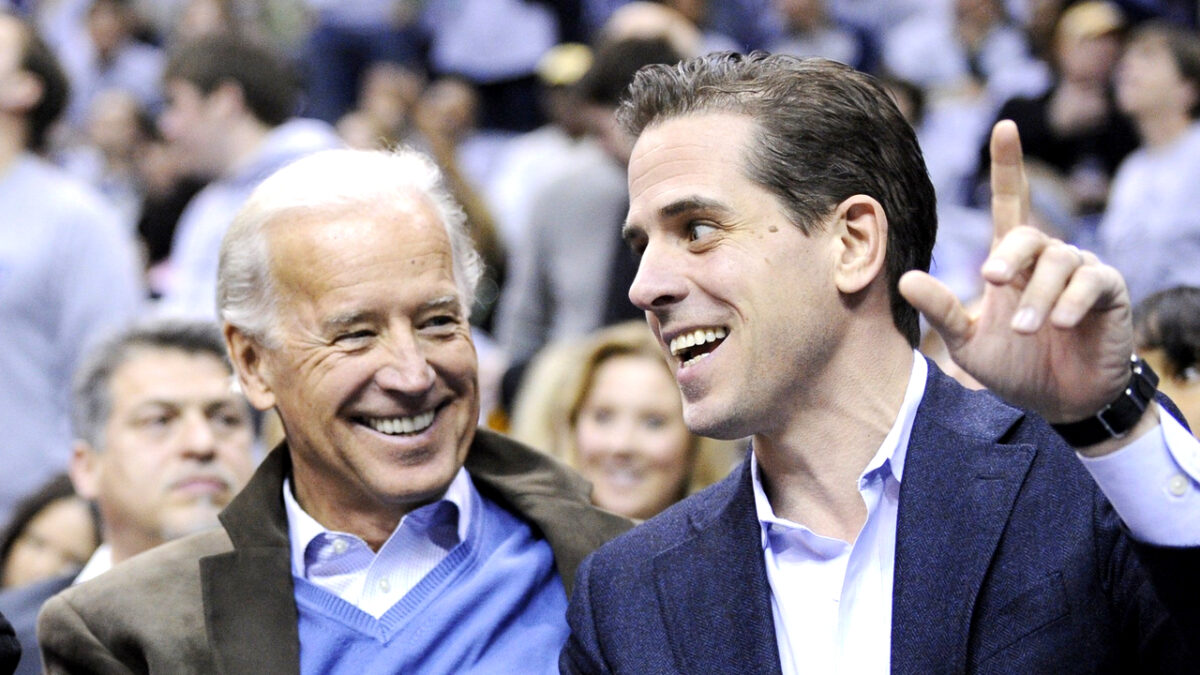
Former Vice President Joe Biden (L) and his son Hunter Biden at the
Duke Georgetown NCAA college basketball game in Washington on Jan. 30,
2010. (Nick Wass/AP Photo)
At an event in 2018, Biden said that in 2016 he had threatened to
withhold $1 billion in aid from Ukraine unless then-President Petro
Poroshenko fired Viktor Shokin. Shokin at the time was investigating
Burisma, an energy company in Ukraine for which Hunter was a board
member from 2014 to at least 2018.
Biden in 2016 was responsible for overseeing anti-corruption efforts in Ukraine.
“I looked at them and said: I’m leaving in six hours. If the prosecutor is not fired, you’re not getting the money,” Biden recounted at an event at the Council on Foreign Relations in 2018. “Well, son of a [expletive], he got fired. And they put in place someone who was solid at the time.”
Hunter Biden has said he consulted for Burisma but critics have
suggested he was not doing actual work in return for his substantial
income—an allegation he denies.
Biden previously denied using his influence to get Shokin fired to
prevent him from investigating Hunter’s involvement. Biden claimed that
the reason that Shokin was fired was because Shokin was inept.
In direct contrast to Biden’s claims, Shokin said in a sworn affidavit obtained by investigative reporter John Solomon that he was told that he was fired in March 2016 because Biden wasn’t pleased with the investigations into Burisma.
Greene alleges that Joe Biden abused his power as the country’s vice
president by allowing his son “to influence the domestic policy of a
foreign nation and accept various benefits—including financial
compensation—from foreign nationals in exchange for certain favors.”
“During his father’s vice presidency, Hunter Biden built many
business relationships with foreign nationals and received millions of
dollars from foreign sources, seemingly in exchange for access to his
father. The financial transactions which Hunter engaged in illustrates
serious counterintelligence and extortion concerns relating to Hunter
Biden and his family,” Greene’s office said.
“President Biden gravely endangered the security of the United States
and its institutions of government. Through blatant nepotism, he
enabled his son to influence foreign policy and financially benefit as a
result of his role as Vice President.
“He supported his son engaging in collusion with Chinese Communist
party-linked officials. He allowed his son to trade appointments with
his father and other high-ranking administration officials in exchange
for financial compensation. He permitted his son to take money from
Russian oligarchs, including Elena Baturina, the wife of the former
mayor of Moscow,” it continued.
The New York Post
last year obtained emails and messages from a laptop allegedly
belonging to Hunter Biden, allegedly showing that he had tried to
arrange a meeting between himself, his father, and a top executive at
Burisma. Both Bidens have denied that a meeting took place, with Joe
Biden saying that the story by the outlet was “another smear campaign.”
Other emails obtained by the outlet allegedly show that Hunter Biden was engaged in deals involving a Chinese energy giant with ties to the Chinese military–the now-bankrupt Chinese oil giant CEFC China Energy.
Tony Bobulinski, a former business partner of Hunter Biden, announced during
a press conference in Nashville in October 2020 that Hunter and his
associates brought him into a deal with CEFC China Energy in 2017.
A federal appeals court in New York in late December 2020 upheld the bribery conviction of Patrick Ho, a Chinese businessman and the former head of a think tank funded by CEFC China Energy.
Hunter is currently under federal investigation
by the U.S. Attorney’s Office in Delaware over his taxes. The details
and nature of the investigation have not been publicly disclosed. The
office said it couldn’t comment on ongoing investigations.
Sen. Chris Coons (D-Del.), a friend and adviser to Biden, said in December 2020 that Joe Biden will not interfere in the investigation. The then-president elect said that he was “confident” his son did nothing wrong, and later said that accusations against Hunter Biden are “foul play.”
(Judge Alex Kozinski, Chief Judge on the 9th US
Circuit Court of Appeals) Judge Alex Kozinski a federal judge, appointed by President Ronald Reagan, resigned January 1st, 2018 after multiple former
clerks and junior staffers came forward with allegations of sexual
misconduct against him. These charges had been made, investigated, and dismissed in 2008.
Judge
Alex Kozinski was for many years Chief Judge on the 9th US
Circuit Court of Appeals, will resign immediately, according to a
statement released by his attorney.
He apologizes for his actions but also defends his "broad sense of humor."
"I've
always had a broad sense of humor and a candid way of speaking to both
male and female law clerks alike. In doing so, I may not have been
mindful enough of the special challenges and pressures that women face
in the workplace. It grieves me to learn that I caused any of my clerks
to feel uncomfortable; this was never my intent," Kozinski wrote.
"For this I sincerely apologize," he said.
In 2008, the Los Angeles Times revealed that the judge had maintained an email list of friends and acquaintances who share his brand of humor, that he used to distribute crude jokes, some of them sexually themed, and that he had a publicly accessible website that contained pornographic images. Anthony J. Scirica, then the Chief Judge of the U.S. Court of Appeals for the 3rd Circuit, who some believe was murdered while on a hunting trip in Texas near the Mexican Border, wrote at the time
that Kozinski’s “conduct exhibiting poor judgment with respect to this
material created a public controversy that can reasonably be seen as
having resulted in embarrassment to the institution of the federal
judiciary.”
"Family
and friends have urged me to stay on, at least long enough to defend
myself. But I cannot be an effective judge and simultaneously fight this
battle. Nor would such a battle be good for my beloved federal
judiciary," he said.
Kozinski also said he is "proud" of the "success" of his clerks.
"It
has also been my privilege to help train the best and the brightest of
several generations of new attorneys. I was made better by working with
them," he wrote. "My clerks went on to stellar careers in law, business
and academics. Their success has made me proud and I am gratified by the
outpouring of support I have received privately from so many of them."
A former clerk for Judge Alex Kozinski said the powerful and
well-known jurist, who for many years served as chief judge on the U.S.
Court of Appeals for the 9th Circuit, called her into his office several
times and pulled up pornography on his computer, asking if she thought
it was photoshopped or if it aroused her sexually. Heidi Bond,
who clerked for Kozinski from 2006 to 2007, said the porn was not
related to any case. One set of images she remembered was of college-age
students at a party where “some people were inexplicably naked while
everyone else was clothed.” Another was a sort of digital flip book that
allowed users to mix and match heads, torsos and legs to create an
image of a naked woman.
Bond is one of six women — all former
clerks or more junior staffers known as externs in the 9th Circuit — who
alleged that Kozinski, now 67
and still serving as a judge on the court, subjected them to a range of
inappropriate sexual conduct or comments. She is one of two former
clerks who said Kozinski asked them to view porn in his chambers.
In
a statement, Kozinski said: “I have been a judge for 35 years and
during that time have had over 500 employees in my chambers. I treat all
of my employees as family and work very closely with most of them. I
would never intentionally do anything to offend anyone and it is
regrettable that a handful have been offended by something I may have
said or done.”
Kozinski provided the statement
after The Post called and emailed a spokesman with a detailed list of
the allegations this story would include. After the story posted online,
the judge said, “I don’t remember ever showing
pornographic material to my clerks” and, “If this is all they are able
to dredge up after 35 years, I am not too worried.”
When Bond was clerking, Kozinski was on the precipice of becoming chief
judge for the 9th Circuit — the largest federal appeals court circuit in
the country, handling cases for a large swath of the western United
States as well as Hawaii and Alaska. The other people who alleged that
Kozinski behaved inappropriately toward them worked in the 9th Circuit
both before and after her, up to 2012.
Bond said she knew that she was to come to the judge’s office when
her phone beeped twice. She said she tried to answer Kozinski’s
inquiries as succinctly and matter-of-factly as possible. Bond was then
in her early 30s and is now 41.
If the question was about
photoshopping, Bond said, she would focus on minor details of the
images. If Kozinski asked whether the images aroused her, Bond said, she
would respond: “No, this kind of stuff doesn’t do anything for me. Is
there anything else you need?” She said she recalled three instances
when the judge showed her porn in his office.
“I was in a state
of emotional shock, and what I really wanted to do was be as small as
possible and make as few movements as possible and to say as little as
possible to get out,” Bond said.
Bond, who went on to clerk for
the Supreme Court and now works as a romance novelist writing under the
name Courtney Milan, and another clerk, Emily Murphy, who worked for a
different judge on the 9th Circuit and is now a law professor, described
their experiences in on-the-record interviews. The other four women
spoke on the condition that their names and some other identifying
information not be published, out of fear that they might face
retaliation from Kozinski or others.
Kozinski, who served as the chief judge on the 9th Circuit from 2007
to 2014, remains a prominent judge, well known in the legal community
for his colorful written opinions. His clerks often win prestigious
clerkships at the Supreme Court.
Murphy, who clerked for Judge
Richard Paez, said Kozinski approached her when she was talking with a
group of other clerks at a reception at a San Francisco hotel in
September 2012. The group had been discussing training regimens, and
Murphy said she commented that the gym in the 9th Circuit courthouse was
nice because other people were seldom there.
Kozinski,
according to Murphy and two others present at the time who spoke to The
Post, said that if that were the case, she should work out naked. Those
in the group tried to change the subject, Murphy and the others present
said, but the judge kept steering the conversation toward the idea of
Murphy exercising without clothes.
“It wasn’t just clear that he
was imagining me naked, he was trying to invite other people — my
professional colleagues — to do so as well,” Murphy said. “That was what
was humiliating about it.”
Murphy, who was 30 at the time of the incident and is now 36,
provided The Post with a 2012 email showing that she told a mentor about
what had happened at the time. Two of Murphy’s friends who were present
at the time of the encounter, speaking on the condition of anonymity,
also confirmed her account.
Bond, similarly, provided emails
showing that she told a friend what had happened at least as of 2008.
The friend, fellow romance novelist Eve Ortega, provided the same
emails. She confirmed that Bond had told her years ago that Kozinski
made inappropriate sexual comments and showed her porn.
Kozinski has previously been embroiled in controversies related to sexually explicit material.
In 2008, the Los Angeles Times revealed that the judge had maintained an email list that he used to distribute crude jokes, some of them sexually themed, and that he had a publicly accessible website that contained pornographic images.
A
judicial investigation ultimately found that Kozinski did not intend to
allow the public to see the material and that, instead, the judge and
his son were careless in protecting a private server from being
accessible on the Internet.
Anthony J. Scirica, then the chief judge of the U.S. Court of Appeals for the 3rd Circuit, wrote at the time
that Kozinski’s “conduct exhibiting poor judgment with respect to this
material created a public controversy that can reasonably be seen as
having resulted in embarrassment to the institution of the federal
judiciary.”
According to Scirica’s report, Kozinski said that he
used the server to keep a variety of items he received by email,
including TV commercials, video clips, cartoons, games and song
parodies.
Of the sexually explicit files, Kozinski testified:
“Some I thought were odd or funny or bizarre, but mostly I don’t have a
very good reason for holding onto them. I certainly did not send them to
anyone else or ask anyone to send me similar files,” according to
Scirica’s report.
Kozinski also testified that he “does not visit and has no interest
in pornographic websites,” according to Scirica’s report. He separately apologized for any embarrassment he had caused in maintaining the email list and said he had stopped sending the jokes.
Bond
said the images Kozinski showed her seemed to come from his private
server, because he pulled them from a site containing the term
“kozinski.com.”
The other Kozinski clerk who said the judge
showed her porn declined to provide specifics out of fear that Kozinski
would be able to identify her. Bond said the judge also showed her a
chart he claimed he and his friends from college had made to list the
women with whom they had had sexual relations.
Bond said that
either Kozinski or his administrative assistant reached out to her
around the time of the news reporting on his private server, asking
whether she would be willing to defend his character. She wrote to
Ortega about the inquiry in 2008, according to emails the women shared
with The Post, and Ortega responded that it “sounds like a very bad idea
to me.”
“I know he brought you into his office to show you porn,
I know he made sexual innuendos to you. I know this because you told me
so in DC, and you even used the words sexual harassment,” Ortega wrote.
“You said you would warn off other women thinking of clerking for him.
And if there’s a woman out there he harassed worse than you, do you
really want to be pitted against her? Because that’s what it would be.
I’m worried that this is what he’s asking you to do — to be the female,
intelligent face of his defense and make whoever it is accusing him look
like a stupid slut, and then he hopefully never has to actually address
those allegations.”
Kozinski was born in Romania to Holocaust
survivors in 1950, and the family fled the communist state when he was a
boy. Decades ago, long before he was a federal judge, he appeared on
the television show “The Dating Game,” planting a kiss on a surprised young woman who selected him for a date. He is married and has three sons.
Kozinski
was appointed to the 9th Circuit by President Ronald Reagan in 1985. He
is an atypical federal appeals court judge — authoring irreverent
opinions and not shying, as many of his colleagues do, from media
appearances.
He styled one opinion in 2012 not as a traditional concurrence or dissent, but instead as “disagreeing with everyone.”
He famously wrote during a trademark dispute between the toy company
Mattel and the record company that produced the 1997 song “Barbie Girl”:
“The parties are advised to chill.”
In
more recent years, Kozinski wrote that using lethal injections to
impose the death penalty was “a misguided effort to mask the brutality
of executions by making them look serene and beautiful — like something
any one of us might experience in our final moments,” and he told the Los Angeles Times, “I personally think we should go to the guillotine, but shooting is probably the right way to go.”
A former Kozinski extern said the judge once made a
comment about her hair and looked her body up and down “in a
less-than-professional way.” That extern said Kozinski also once talked
with her about a female judge stripping.
“I didn’t want to be alone with him,” the former extern said.
A
different former extern said she, similarly, had at least two
conversations “that had sexual overtones directed at me,” and she told
friends about them at the time. One of the friends, also a former
extern, confirmed that the woman had told her about the remarks — though
both declined to detail them for fear of being identified.
One
former 9th Circuit clerk said she was at a dinner in Seattle, seated
next to Kozinski, when he “kind of picked the tablecloth up so that he
could see the bottom half of me, my legs.” She said Kozinski remarked,
“I wanted to see if you were wearing pants because it’s cold out.” The
former clerk said she was wearing pants at the time. The incident, she
said, occurred in late 2011 or early 2012.
“It made me uncomfortable, and it didn’t seem appropriate,” said the former clerk, who worked for a different judge.
All
of the women The Post interviewed said they did not file formal
complaints at the time. Bond said Kozinski had so vigorously stressed
the idea of judicial confidentiality — that what is discussed in
chambers cannot be revealed to the outside — that she questioned even
years later whether she could share what had happened with a therapist,
even though she had already talked with Ortega about it.
Bond
said Kozinski worked his clerks so hard that “there was no thought that I
could see him as anything other than in complete control,” and she
feared that not leaving with a good recommendation from him might
jeopardize her career.
“I did think about walking away and concluded I just didn’t know what I would do if I did,” Bond said.
The
other former Kozinski clerk who said the judge asked her to watch porn
in his chambers said she both feared what he might do and knew that a
complaint was unlikely to strip him of his influence.
“I was afraid,” the former clerk said. “I mean, who would I tell? Who do you even tell? Who do you go to?”
Murphy
said she discussed what had happened with the judge for whom she was
clerking, and he was supportive of her filing a complaint. But because
the complaint would first go to Kozinski himself, then be referred
elsewhere, Murphy said she chose not to proceed. The judge, Paez,
declined to comment for this report through a representative.
As a
judge, Kozinski has addressed the topic of sexual harassment in
important ways. In 1991, he joined an opinion that decided such cases
should be judged from the perspective of the victims, using what was
then called the “reasonable woman” standard. The opinion,
written by then-Judge Robert R. Beezer, noted pointedly, “Conduct that
many men consider unobjectionable may offend many women.”
Beezer died in 2012. Kozinski himself wrote about sexual harassment in 1992, commenting on how legal remedies could come with unforeseen consequences.
He
wrote that men “must be aware of the boundaries of propriety and learn
to stay well within them,” while women “must be vigilant of their
rights, but must also have some forgiveness for human foibles: misplaced
humor, misunderstanding, or just plain stupidity.”
He acknowledged, though, that the problem of harassment was a real one.
“But
who knew, who understood, that it was quite so pervasive,” Kozinski
wrote. “Apparently most women did, while most men did not. It was the
best-kept secret of modern times.”
He Made Us All Victims and Accomplices
For 20 years, I’ve felt it was too early to speak up about Judge Alex Kozinski. Now I fear it’s too late.
The first time I met Alex Kozinski was in 1996. I was clerking for the chief judge of the 9th
U.S. Circuit Court of Appeals, and there was an orientation for new
clerks in San Francisco. One of my co-clerks and I were introduced to
the already legendary, lifetime-tenured young judge at a reception, and
we talked for a while. I cannot recall what we talked about. I remember
only feeling quite small and very dirty. Without my prompting, my former
co-clerk described this interaction in an email to me this week. “He
completely ignored me and appeared to be undressing you with his eyes,”
he wrote. “I had never seen anyone ogle another person like that and
still have not seen anything like it. Was so uncomfortable to watch, and
I wasn’t even the subject of the stare.”
The first time I spoke to Judge Kozinski on the phone came weeks
later, when I called his chambers late at night. Our judge had a sitting
in the same city as Judge Kozinski, and I had made plans with one of
Kozinski’s then-clerks, an old college friend, to meet late at night for
a drink. When I called his chambers, Judge Kozinski himself answered
the phone. I introduced myself and asked to speak to his clerk,
explaining that we had plans to meet up. The judge asked where I was. I
said I was in my hotel room. Then he said, “What are you wearing?”
I was taken aback, in part because nobody talked this way in real
life. I surprised myself by reporting what Kozinski had said to my
judge, who had always been kind and courtly and old-fashioned to the
point of being almost saintly in my eyes. He looked horrified, as I am
sure he was. But it was 1996. And the relationships between law clerks
and their judges are mostly built on worshipful silence. There is no
other work relationship left in America that is comparable. Which is, as
it happens, part of the problem.
For the 20 intervening years, I have promised myself that if Judge
Kozinski was ever to appear before the Senate Judiciary Committee for a
Supreme Court confirmation hearing, I would testify about the dozens of
conversations I’d had over the years with other clerks and lawyers about
Kozinski’s behavior, about the strange hypersexualized world
of transgressive talk and action that embodied his chambers. It turns
out, it didn’t take a confirmation hearing to kick off this
conversation. On Dec. 8, the Washington Postpublished the stories of six women—two of them, Heidi Bond
and Emily Murphy, brave enough to go on the record—alleging that
Kozinski had harassed them when they clerked or otherwise worked for
him, or when they clerked for another 9th Circuit judge. Bond
says Kozinski pulled up pornography on a computer in his chambers and
asked if it aroused her. One accuser spoke of him looking “her body up
and down ‘in a less-than-professional way.’ ” Another reported about his
fixation on the idea that she should exercise naked.
In a statement to the Post, Kozinski said, “I have been a
judge for 35 years and during that time have had over 500 employees in
my chambers. I treat all of my employees as family and work very closely
with most of them. I would never intentionally do anything to offend
anyone and it is regrettable that a handful have been offended by
something I may have said or done.” After the Post story was published, he additionally told the Los Angeles Times,
“I don’t remember ever showing pornographic material to my clerks,” and
“If this is all they are able to dredge up after 35 years, I am not too
worried.” He also noted that Bond had written a romance novel that
featured “very torrid sex.” Kozinski has not replied to Slate’s request for comment as of publication time.
I never reported to Judge Kozinski during my tenure at the 9th
Circuit, so my story is different. Nevertheless, I believe Bond and
Murphy, because the pattern they describe is a familiar one. It is hard
to put into words what felt off to me about Judge Kozinski’s behavior.
To start, I would suggest you watch this infamous video from 1968 of the
future judge delivering an egregious kiss to his prospective date on an
episode of TheDating Game.
Nothing like that happened to me. But perhaps it helps you understand
why, even though he never put his mouth directly on mine or clasped my
throat, his consistent way of greeting me—with a kiss on the cheek that
always lasted a few seconds too long, in front of colleagues I respected
if not revered, so prolonged that others noted it—was unwanted.
And yet I still don’t quite know the word for it. In so many of his
interactions with me, and conversations around me, Judge Kozinski has
always gone one step over the line of appropriate sexual discourse. At
the same time, he pushes a worldview that suggests there is no such
thing as a line. Both personally and in his jurisprudence, I don’t think
he believes that porn is porn, or that sex talk is problematic in the
workplace. His acts of darting back and forth into deep sexual taboo
became a natural experiment in who would live there with him. But
because he is powerful, and because relationships with him are proximate
to yet more power, those in his circle got dragged along into a world
that diminishes and belittles women. For more evidence of this, you can
read this diary entry he wrote for Slate in 1996, describing an outing with an unnamed clerk to attend a lingerie party.
Kozinski forced us all into this mess with him. And still, I am aware
as I write this that I should have found my footing, that the women who
came up after me, and who spoke up, are manifestly braver than I was. I
am further aware that my failure to speak up over the course of my
career is part of the reason why it was possible for the women who came
after me to be treated as disrespectfully as they were.
I have seen Judge Kozinski dozens of times in the past two decades,
moderated his panels, sat next to him at high-powered, high-status
events and dinners. My husband will tell you he once fielded a call from
the judge to my home, in which Kozinski described himself as my
“paramour.” I have, on every single such occasion, been aware that part
of his open flouting of empathy or care around gender was a show of
juvenile, formulaic bad-assery designed to co-opt you into the bargain.
We all ended up colluding to pretend that this was all funny or benign,
and that, since everyone knew about it, it must be OK. It never was.
At a different reception in a different hotel in San Francisco this
past summer, a friend was so shocked watching the judge greet me with
yet another too-long, too-exuberant public kiss that he felt he had to
check in with me later. I was mortified, as my texts that night
reflected. The fact that I had simply acceded to this treatment, at age
50, with teenage children, took my breath away. I texted my husband and
my two best friends. But this was our deal. I’d always agreed to it.
But now it’s 2017, and along with thinking about Heidi Bond, Emily Murphy, and those who came forward anonymously, I am also thinking about those who opted not to apply for clerkships with him,
sidestepping an opportunity to get within close range of a coveted
Supreme Court clerkship. Like others who have now come forward, I had
told young female law students not to clerk for him.
I am thinking about the hundreds of plaintiffs in the discrimination and harassment suits he heard
in the years he was on the bench. I am thinking of all the ways in
which “open secrets” become their own spheres of truth, in which the
idea that “everybody knew” something awful absolved all of us of the
burden of doing anything. The former Kozinski and 9th Circuit
clerks I’ve spoken to in recent days feel heartsick, as I do, that for
the sake of our own careers and professional legitimacy we continued to
go to the dinners and moderate the panels, all the while hoping this
story would break someday and we’d be off the hook. Some of these clerks
are still encumbered by the norms that constrained Bond,
norms that stipulate that clerks must not speak out against or question
their judges, norms to which Kozinski insisted strict adherence—and
norms that, it must be said, are insane on their face if they prevent reports of open sexual harassment.
Everybody knew.
This is the problem with a system of “open secrets.” All the clerks and
former clerks in Kozinski’s ambit knew and understood that you assumed
the risk and accepted the responsibilities of secrecy. Once you acceded
to the poker games and the movies and the ritualized sex talk, you
helped give it cover and license. To sit at a table with Judge Kozinski
was to suspend rules for how judges talk and behave. The swearing and
the gleeful overt talk of sexuality wasn’t just part of the bargain of
being around him. Our silence became tacit approval of that chambers’
gleeful rejection of the strictures of political correctness and of the
social imperative to police oneself.
This story really shouldn’t be about me. I never worked for Kozinski,
and even though his behavior affected me, my future never depended on
him. But here is the part that does implicate me: When a prominent
journalist with a national platform chooses—year after year—not to
report on an open secret, or agrees to slouch through yet another dinner
or panel or cocktail party, how can it only be about the victims and
the harassers? Because really, if you can’t tell a man to back off when
you’re 50 and at the peak of your journalistic power, who is ever going
to do it? Back in the ’90s, it was too early to report what I knew, what
we all knew. And now it is too late. As my friend Rebecca Traister has put it,
“the stink got on me anyway. I was implicated. We all are, our
professional contributions weighed on scales of fuckability and
willingness to go along, to be good sports, to not be humorless scolds
or office gorgons.”
I take no joy in this reporting. Kozinski is brilliant and wickedly
talented. He has done important work on police and prosecutorial
misconduct in particular, and if he is to be replaced, it will likely be
with a 35-year-old Trump pick who diminishes women systemically, if not
recreationally. Not a net win, if we are even trying to keep score for women anymore.
But if this moment is going to mean anything, it has to make room for
the realization that every last one of us who gave cover to this type
of systematic degradation and abuse of power is at the very least
responsible for calling it out for what it was. We are also responsible
for apologizing, and figuring out how we can start to do better. I have
written extensively about the gendered pipeline to Supreme Court clerkships. Until now, I have failed to mention that the pipeline sometimes demanded the ritualized humiliation of young women.
For years, I excused myself because I believed that the casual
degradation of women that emanated from Judge Kozinski’s orbit was the
death rattle of an old America: a symbol of the sad, broken longing for
the world of Mad Men, a world that ended as soon as women
reached parity with men in law school. Donald Trump and his foot
soldiers are proof that this old America is very much alive, and that
it’s in fact a full-scale project to treat women as trivial and
ornamental and to hold them back. It keeps brilliant women from accessing power
and dismisses other brilliant women as hysterics—the “nutty and slutty”
character assassination used to trash Anita Hill. It’s disturbing to
realize that, even today, the main markers I relied on to confirm
Kozinski’s bad behavior were the shocked reactions of normal, good men:
my husband, my friend, my co-clerk. Sure, I felt dirty after each
interaction, but my feelings didn’t feel like enough.
I always figured I would feel better when Judge Kozinski’s #MeToo came home to roost. I don’t. His reactions to the accusers—belittling
their allegations, shaming Bond for writing sex scenes in romance
novels—were the reactions I was trying to avoid bringing down on myself
when I failed to insist that Article III judges not talk to and about
women this way, not at work, and not as we struggled to find purchase in
the profession of our choosing. Somewhere along the way I managed to
create a career for myself. In part, I did it by keeping secrets. I’d
like to be done with that now.
Ministers face a 180-day jail term and $1,000 fine for each day they decline to celebrate the same-sex wedding.
Just this weekend, a case has arisen in Idaho, where city officials
have told ordained ministers they have to celebrate same-sex weddings or
face fines and jail time.
The Idaho case involves Donald and Evelyn Knapp, both ordained ministers, who run Hitching Post Wedding Chapel.
Officials from Coeur d’Alene, Idaho, told the couple that because the
city has a non-discrimination statute that includes sexual orientation
and gender identity, and because the 9th U.S. Circuit Court of Appeals
struck down Idaho’s constitutional amendment defining marriage as the
union of a man and a woman, the couple would have to officiate at
same-sex weddings in their own chapel.
The non-discrimination statute applies to all “public accommodations,” and the city views the chapel as a public accommodation.
On Friday October 17, a same-sex couple asked to be married by the Knapps, and
the Knapps politely declined. The Knapps now face a 180-day jail term
and $1,000 finefor each daythey decline to celebrate the same-sex wedding.
A week of honoring their faith and declining to perform the ceremony
could cost the couple three and a half years in jail and $7,000 in
fines. Government Coercion
The Knapps have been married to each other for 47 years and are both
ordained ministers of the International Church of the Foursquare Gospel.
They are“evangelical Christians who hold to historic Christian beliefs” that
“God created two distinct genders in His image” and “that God ordained
marriage to be between one man and one woman.”
But as a result of the courts redefining marriage and a city
ordinance that creates special privileges based on sexual orientation
and gender identity, the Knapps are facing government coercion.
Governmental recognition of same-sex relationships as marriages need
not and should not require any third party to recognize a same-sex
relationship as a marriage. Government should respect the rights of all
citizens. Indeed, a form of government respectful of free association,
free contracts, free speech and free exercise of religion should protect
citizens’ rights to live according to their beliefs about marriage.
The Knapps have been celebrating weddings in their chapel since 1989.
Government should not now force them to shut down or violate their
beliefs.
After all, protecting religious liberty and the rights of conscience does
not infringe on anyone’s sexual freedoms. No one has a right to have
the government force a particular minister to marry them. Some citizens
may conclude that they cannot in good conscience participate in same-sex
ceremonies, from priests and pastors to bakers and florists. They
should not be forced to choose between strongly held religious beliefs
and their livelihood. What Can Be Done
At the federal level, Congress has an opportunity to protect religious liberty and the rights of conscience.
Government should not now force ordained ministers to shut down or violate their beliefs.
Policy should prohibit the government from discriminating against any
individual or group, whether nonprofit or for-profit, based on their
beliefs that marriage is the union of a man and woman or that sexual
relations are reserved for marriage. The government should be prohibited
from discriminating against such groups or individuals in tax policy,
employment, licensing, accreditation or contracting.
The Marriage and Religious Freedom Act—sponsored
by Rep. Raul Labrador, R-Idaho, in the House (H.R. 3133) with more than
100 co-sponsors of both parties, and sponsored by Sen. Mike Lee,
R-Utah, in the Senate (S. 1808) with 17 co-sponsors—would prevent the
federal government from taking such adverse actions.
States need similar policy protections, including broad protections
provided by state-level Religious Freedom Restoration Acts (RFRAs) and
specific protections for beliefs and actions about marriage.
Indeed, Idaho has a RFRA, called the Free Exercise of Religion
Protected Act (FERPA). State RFRAs prevent the imposition of substantial
burdens on sincere religious beliefs unless the government proves that
such a burden advances a compelling government interest that has been
pursued through the least restrictive means possible. Protecting Religious Liberty
It is unclear how the city could claim that forcing the Knapps to
perform a same-sex wedding is a compelling government interest being
pursued in the least restrictive way. There are numerous other venues
where a same-sex couple could get married. Indeed, there is a county
clerks office directly across the street from the chapel.
States must protect the rights of Americans and the associations they
form—both nonprofit and for-profit—to speak and act in the public
square in accordance with their beliefs. It is particularly egregious
that the city would coerce ordained ministers to celebrate a religious
ceremony in their chapel. The Alliance Defending Freedom has filed a motion
arguing that this action “violates [the Knapps’s] First and 14th
Amendment rights to freedom of speech, the free exercise of religion,
substantive due process, and equal protection.”
Citizens must work to prevent or repeal laws that create special privileges based on sexual orientation and gender identity. We must also insist on laws that protect religious freedom and the rights of conscience.
Protecting religious liberty and the rights of conscience is the
embodiment of a principled pluralism that fosters a more diverse civil
sphere. Indeed, tolerance is essential to promoting peaceful coexistence
even amid disagreement.(By Ryan T. Anderson
)
I am a thoroughly civilized, humane, cosmopolitan, polished, restrained, enjoyable, entertaining Info-maniac. I am a staunch exponent of individual dignity, freedom, equal access to legal services, and equal protection of the law. Here I hope to demonstrate my emotional restraint, humbleness of sentiment, psychological subtlety, lucid style, and simple language, without evading political reality or eternal truth. Daily I am excited that I have the right to create the beginning of a new self and to challenge old habits and attitudes I no longer choose to accept. I choose to relax in the present with my direction firmly in mind. I have an enormous capacity for creative and clever ideas and thoughts. It is phenomenal what I can do. I am capable of so much learning and absorbing a lot of information. My potential is a source of pleasant surprise for me.
Each day, I increase in knowledge, skills, strength, faith, and abilities.With each adventure, the boundary hemming in my potential expands easily to accomodate my growth and achievements.



For years, those in favor of same-sex marriage have argued that all Americans should be free to live as they choose. And yet in countless cases, the government has coerced those who simply wish to be free to live in accordance with their belief that marriage is the union of a man and a woman. Just this weekend, a case has arisen in Idaho, where city officials have told ordained ministers they have to celebrate same-sex weddings or face fines and jail time.
The Idaho case involves Donald and Evelyn Knapp, both ordained ministers, who run Hitching Post Wedding Chapel. Officials from Coeur d’Alene, Idaho, told the couple that because the city has a non-discrimination statute that includes sexual orientation and gender identity, and because the 9th U.S. Circuit Court of Appeals struck down Idaho’s constitutional amendment defining marriage as the union of a man and a woman, the couple would have to officiate at same-sex weddings in their own chapel.
The non-discrimination statute applies to all “public accommodations,” and the city views the chapel as a public accommodation.
On Friday October 17, a same-sex couple asked to be married by the Knapps, and the Knapps politely declined. The Knapps now face a 180-day jail term and $1,000 fine for each day they decline to celebrate the same-sex wedding.
A week of honoring their faith and declining to perform the ceremony could cost the couple three and a half years in jail and $7,000 in fines.
Government Coercion
The Knapps have been married to each other for 47 years and are both ordained ministers of the International Church of the Foursquare Gospel. They are “evangelical Christians who hold to historic Christian beliefs” that “God created two distinct genders in His image” and “that God ordained marriage to be between one man and one woman.”
But as a result of the courts redefining marriage and a city ordinance that creates special privileges based on sexual orientation and gender identity, the Knapps are facing government coercion.
Governmental recognition of same-sex relationships as marriages need not and should not require any third party to recognize a same-sex relationship as a marriage. Government should respect the rights of all citizens. Indeed, a form of government respectful of free association, free contracts, free speech and free exercise of religion should protect citizens’ rights to live according to their beliefs about marriage.
The Knapps have been celebrating weddings in their chapel since 1989. Government should not now force them to shut down or violate their beliefs.
After all, protecting religious liberty and the rights of conscience does not infringe on anyone’s sexual freedoms. No one has a right to have the government force a particular minister to marry them. Some citizens may conclude that they cannot in good conscience participate in same-sex ceremonies, from priests and pastors to bakers and florists. They should not be forced to choose between strongly held religious beliefs and their livelihood.
What Can Be Done
At the federal level, Congress has an opportunity to protect religious liberty and the rights of conscience.
Policy should prohibit the government from discriminating against any individual or group, whether nonprofit or for-profit, based on their beliefs that marriage is the union of a man and woman or that sexual relations are reserved for marriage. The government should be prohibited from discriminating against such groups or individuals in tax policy, employment, licensing, accreditation or contracting.
The Marriage and Religious Freedom Act—sponsored by Rep. Raul Labrador, R-Idaho, in the House (H.R. 3133) with more than 100 co-sponsors of both parties, and sponsored by Sen. Mike Lee, R-Utah, in the Senate (S. 1808) with 17 co-sponsors—would prevent the federal government from taking such adverse actions.
States need similar policy protections, including broad protections provided by state-level Religious Freedom Restoration Acts (RFRAs) and specific protections for beliefs and actions about marriage.
Indeed, Idaho has a RFRA, called the Free Exercise of Religion Protected Act (FERPA). State RFRAs prevent the imposition of substantial burdens on sincere religious beliefs unless the government proves that such a burden advances a compelling government interest that has been pursued through the least restrictive means possible.
Protecting Religious Liberty
It is unclear how the city could claim that forcing the Knapps to perform a same-sex wedding is a compelling government interest being pursued in the least restrictive way. There are numerous other venues where a same-sex couple could get married. Indeed, there is a county clerks office directly across the street from the chapel.
States must protect the rights of Americans and the associations they form—both nonprofit and for-profit—to speak and act in the public square in accordance with their beliefs. It is particularly egregious that the city would coerce ordained ministers to celebrate a religious ceremony in their chapel. The Alliance Defending Freedom has filed a motion arguing that this action “violates [the Knapps’s] First and 14th Amendment rights to freedom of speech, the free exercise of religion, substantive due process, and equal protection.”
Citizens must work to prevent or repeal laws that create special privileges based on sexual orientation and gender identity. We must also insist on laws that protect religious freedom and the rights of conscience.
Protecting religious liberty and the rights of conscience is the embodiment of a principled pluralism that fosters a more diverse civil sphere. Indeed, tolerance is essential to promoting peaceful coexistence even amid disagreement.(By Ryan T. Anderson )