MILES v. SOCIAL SECURITY ADMINISTRATION
PATRICIA ANN MILES v. SOCIAL SECURITY ADMINISTRATION, COMMISSIONER.
No. 11-13042, Non-Argument Calendar.
United States Court of Appeals, Eleventh Circuit.
Filed March 15, 2012.
Before BARKETT, MARTIN and ANDERSON, Circuit Judges.
PER CURIAM.
Patricia Ann Miles appeals, pro se, (that means she did not have an attorney. She tried to do it herself. That is her right, but a person who represents herself, has a fool for a client.) the district court’s order affirming the Social Security Administration’s (“SSA”) denial of her application for widow’s insurance benefits . Miles argues that the Administrative Law Judge‘s (“ALJ”) determination regarding her March 1998 residual functioning capacity (“RFC“) was not supported by substantial evidence.1 More specifically, she contends that the ALJ erred by: (1) not considering the record evidence reflecting three doctors’ opinions that she was unable to work due to severe damage to her back; (2) discounting the opinion of her chiropractor that she was completely disabled; and (3) finding that her testimony was not fully credible.
Our review in this case is limited to the materials contained in the certified administrative record.2 We review the SSA’s legal conclusions de novo, and its factual findings to determine whether they are supported by substantial evidence. Substantial evidence is defined as “such relevant evidence as a reasonable person would accept as adequate to support a conclusion.”. “If the [SSA's] decision is supported by substantial evidence we must affirm, even if the proof preponderates against it.”
Under the Social Security Act, the widow of a fully-insured individual is entitled to benefits if she establishes that she is at least 50, but less than 60 years of age, and is disabled. See 20 C.F.R. § 404.335(c). Thus, to collect widow’s Social Security benefits, Miles had to prove that she was disabled, as defined under 20 C.F.R. § 404.1505. The ALJ found, and the parties did not contest, that the prescribed period within which Miles had to demonstrate her disability ran from March 1, 1991 to March 31, 1998. See 42 U.S.C. § 402(e)(1); 20 C.F.R. § 404.336(c) (detailing the eligibility period for widow’s Social Security benefits).
The Social Security Regulations outline a five-step evaluation process used to determine whether a claimant is disabled. The evaluation considers each step in turn, asking: (1) whether the claimant is currently engaged in substantial gainful activity; (2) whether the claimant has a severe impairment or combination of impairments; (3) whether the impairment meets or equals the severity of the specified impairments in the Listing of Impairments; (4) whether, based on an RFC assessment, the claimant can perform any of her past relevant work despite the impairment; and (5) whether there are significant numbers of jobs in the national economy that the claimant can perform, given the claimant’s RFC, age, education, and work experience.
The ALJ determined that Miles met the first two steps of the SSR’s five-step process. At the third step, however, the ALJ found that Miles’s impairments did not meet or equal a listed impairment. Proceeding to the fourth step, the ALJ also found that Miles retained the RFC to perform her past relevant work (PRW), despite her impairment, during the claim period (1991-1998). See 20 C.F.R. §§ 416.920(e), (f). Concluding that Miles had the requisite RFC, the ALJ had no need to proceed to the fifth and final step of the analysis. See id. § 416.920(a)(4)(iv).
Miles argues that substantial evidence does not support the ALJ’s findings relating to her RFC during the prescribed period, and she asserts three specific errors that led to the ALJ’s allegedly erroneous conclusion. First, Miles argues that the ALJ did not consider all the record’s medical evidence, and that he did not accord proper weight to the statements of her treating physicians. Miles is correct that the record contains evidence from a few doctors suggesting that, as early as 2001, she was disabled. But that evidence does not guarantee the success of her claim. 20 C.F.R. §§ 404.1527(e)(1), 416.927(e)(1) (clarifying that a treating physician’s opinion that a claimant is “disabled” is not dispositive, as that ultimate conclusion is a regulatory determination left to the ALJ). Here the ALJ found “good cause” not to heed those medical opinions, determining that they were without any explanation or basis in clinical findings, and were contradicted by the other record evidence. See Phillips, 357 F.3d at 1240-41 (listing these as permissible bases for finding “good cause” to disregard the opinion of a treating physician). Instead, the ALJ relied on the more detailed medical opinions provided by three other examining physicians to find that, prior to April 1, 2003, Miles had the RFC to perform light work, except for repetitive lifting.
Second, Miles argues that the ALJ erred by discounting her chiropractor’s opinion that she was completely disabled. However, an ALJ has no duty to give significant or controlling weight to a chiropractor’s views because, for SSA purposes, a chiropractor is not a “medical source” who can offer medical opinions. See 20 C.F.R. §§ 404.1513, 416.913, 404.1527(a)(2); Crawford v. Comm’r of Soc. Sec., 363 F.3d 1155, 1160 (11th Cir. 2004). Further, as stated above, even a medical source’s statement that a claimant is “unable to work” or “disabled” does not bind the ALJ, who alone makes the ultimate determination as to disability under the regulations. See 20 C.F.R. §§ 404.1527(e)(1), 416.927(e)(1).
Third, Miles disputes that the ALJ’s determination as to her credibility was supported by substantial evidence, where the ALJ found that Miles’s testimony regarding the intensity, persistence and limiting effects of her symptoms were “not entirely credible prior to April 1, 2003.” The ALJ is permitted to reach a conclusion that differs from the subjective testimony of a claimant. See Marbury v. Sullivan, 957 F.2d 837, 839 (11th Cir. 1992) (“After considering a claimant’s complaints of pain, the ALJ may reject them as not creditable . . . .”). In making this finding, the ALJ was required to articulate his reasons for discrediting the subjective testimony. See Wilson v. Barnhart, 284 F.3d 1219, 1225 (11th Cir. 2002); see also Foote v. Chater, 67 F.3d 1553, 1562 (11th Cir. 1995) (“A clearly articulated credibility finding with substantial supporting evidence in the record will not be disturbed by a reviewing court.”). The ALJ did so here, concluding that, despite Miles’s testimony to the contrary, the entirety of the record evidence showed that she possessed the ability to perform significant work activities.
The ALJ reviewed all the evidence before him, accorded more weight to some evidence than to other evidence, and explained his reasons for doing so. We therefore conclude that the ALJ’s determinations are supported by substantial evidence, and we will not disturb his decision. See Miles, 84 F.3d at 1400.
AFFIRMED.
http://www.amazon.com/Judge-London-Steverson/e/B006WQKFJM
Friday, March 16, 2012


Social Security Commissioner Reversed On Appeal.

BAYS v. COMMISSIONER OF SOCIAL SECURITY
KENNETH BAYS, Plaintiff, v. COMMISSIONER OF SOCIAL SECURITY, Defendant.
United States District Court.
March 14, 2012.
Kenneth Bays, Plaintiff, represented by Shea A. Fugate, Law Office of Shea Fugate.
Commissioner of Social Security, Defendant, represented by John F. Rudy, III, US Attorney’s Office – FLM.
http://www.amazon.com/Judge-London-Steverson/e/B006WQKFJM
Memorandum Opinion & Order
DAVID A. BAKER, Magistrate Judge.
Plaintiff brings this action pursuant to the Social Security Act (the Act), as amended, Title 42 United States Code Section 405(g), to obtain judicial review of a final decision of the Commissioner of the Social Security Administration (the Commissioner) denying his claim for Disability Insurance Benefits (DIB) and Supplemental Security Income (SSI) benefits under the Act.
The record has been reviewed, including a transcript of the proceedings before the Administrative Law Judge (ALJ), the exhibits filed and the administrative record, and the pleadings and memoranda submitted by the parties in this case. Oral argument has not been requested.
For the reasons that follow, the decision of the Commissioner is REVERSED and REMANDED.
I. BACKGROUND
A. Procedural History
Plaintiff filed for a period of disability, DIB and SSI benefits on January 27, 2008. He alleged an onset of disability (AOD) on November 8, 2006, due to pain in the lower back, right leg, knee, and hip. His application was denied initially and upon reconsideration. Plaintiff requested a hearing, which was held on September 9, 2009, before Administrative Law Judge Marc Mates (hereinafter referred to as “ALJ”). In a decision dated October 16, 2009, the ALJ found Plaintiff not disabled as defined under the Act through the date of his decision. Plaintiff timely filed a Request for Review of the ALJ’s decision. The Appeals Council denied Plaintiff’s request on June 25, 2010. Plaintiff filed this action for judicial review on October 25, 2010. Doc. No. 1.
B. Medical History and Findings Summary
Plaintiff was born on October 13, 1966 and was 40 years old on the alleged disability onset date (AOD) and forty-three years old at the time of the hearing; had graduated from high school. Prior to November 8, 2006, the alleged onset date of disability. Plaintiff had worked as a laborer, as a brick layer, and as a roofer.(PRW).
Plaintiff’s medical history is set forth in detail in the ALJ’s decision. Approximately twenty years prior to the onset date, Plaintiff was involved in a motorcycle accident and suffered (along with other injuries not relevant here) a fracture of the right femoral shaft, necessitating surgery and placement of a fixation rod in his right leg. For many years, Plaintiff did not have pain from this accident, however, around the beginning of 2008, he began to experience pain in the lower back, in the right leg from a cracked rod in the femur from the accident, in the knee, and hip; he also complained of high blood pressure and anxiety. After reviewing Plaintiff’s medical records and Plaintiff’s testimony, the ALJ found that Plaintiff suffered from complications of an internal orthopedic device (right femur) and spondylolisthesis of L5 upon SI, which were “severe” medically determinable impairments, but not impairments severe enough to meet or medically equal one of the impairments listed in Appendix 1, Subpart P, Regulations No. 4. The ALJ determined that Plaintiff retained the residual functional capacity (RFC) to perform sedentary work which does not involve climbing, although he can engage in all other postural activities, including stooping and crouching, on an occasional basis, with pushing and pulling of the lower extremities is also limited to occasional, and no more than moderate exposure to vibration and hazards. In making this determination, the ALJ found that Plaintiff’s statements regarding his limitations concerning the intensity, persistence, and limiting effects of his symptoms were not credible to the extent they were inconsistent with the ALJ’s residual functional capacity assessment. Based upon Plaintiff’s RFC, the ALJ determined that he could not perform past relevant work (PRW).. Considering Plaintiff’s vocational profile and RFC, the ALJ applied the Medical-Vocational Guidelines (the grids), 20 C.F.R. Pt. 404, Subpt. P, App. 2, and, based on the testimony of the vocational expert (“VE”), the ALJ concluded that Plaintiff could perform work existing in significant numbers in the national economy as routing clerk, surveillance system monitor, and grader/sorter. Accordingly, the ALJ determined that Plaintiff was not under a disability, as defined in the Act, at any time through the date of the decision.
Plaintiff now asserts five points of error. First, he argues that the ALJ erred by by finding he had the RFC to perform sedentary work contrary to statements by his treating physician. Second, Plaintiff argues that the ALJ erred in failing to determine that the claimant suffered from the severe impairment of Spina Bifida Occulta. Third, he contends the ALJ erred by improperly applying the pain standard. Fourth, Plaintiff asserts that the ALJ erred in failing to consider the side effects of his medications. Fifth, he argues that the ALJ erred in evaluating his credibility. All issues are addressed, although not in the order presented by Plaintiff. For the reasons that follow, the decision of the Commissioner is REVERSED and REMANDED.
II. STANDARD OF REVIEW
The scope of this Court’s review is limited to determining whether the ALJ applied the correct legal standards, , and whether the findings are supported by substantial evidence. The Commissioner’s findings of fact are conclusive if supported by substantial evidence. 42 U.S.C. § 405(g). Substantial evidence is more than a scintilla — i.e., the evidence must do more than merely create a suspicion of the existence of a fact, and must include such relevant evidence as a reasonable person would accept as adequate to support the conclusion.
“If the Commissioner’s decision is supported by substantial evidence, this Court must affirm, even if the proof preponderates against it.” “We may not decide facts anew, reweigh the evidence, or substitute our judgment for that of the [Commissioner.]” Id. (internal quotation and citation omitted). The district court must view the evidence as a whole, taking into account evidence favorable as well as unfavorable to the decision. The court must scrutinize the entire record to determine reasonableness of factual findings).
The ALJ must follow five steps in evaluating a claim of disability. See 20 C.F.R. §§ 404.1520, 416.920. First, if a claimant is working at a substantial gainful activity, he is not disabled. 20 C.F.R. § 404.1520(b). Second, if a claimant does not have any impairment or combination of impairments which significantly limit his physical or mental ability to do basic work activities, then he does not have a severe impairment and is not disabled. 20 C.F.R. § 404.1520(c). Third, if a claimant’s impairments meet or equal an impairment listed in 20 C.F.R. Part 404, Subpart P, Appendix 1, he is disabled. 20 C.F.R. § 404.1520(d). Fourth, if a claimant’s impairments do not prevent his from doing past relevant work, he is not disabled. 20 C.F.R. § 404.1520(e). Fifth, if a claimant’s impairments (considering his residual functional capacity, age, education, and past work) prevent his from doing other work that exists in the national economy, then he is disabled. 20 C.F.R. § 404.1520(f).
III. ISSUES AND ANALYSIS
A. A severe impairment
Plaintiff argues that the medical evidence showed he suffered from a severe impairment resulting from spina bifida occulta because this condition resulted in significant limitations, and the impairment was well-documented. The Commissioner argues that the ALJ did not err because he found a severe impairment in Plaintiff’s lower back , even if it was for lumbar spondylolistheses and not spina bifida occulta, and he continued in the analysis to consider Plaintiff’s impairments in the next step in the evaluation process.
At Step 2 of the five-step evaluation process, the ALJ is called upon to determine whether a claimant’s impairments are severe. By definition, this inquiry is a “threshold” inquiry. It allows only claims based on the most trivial impairments to be rejected. In this Circuit, an impairment is not severe only if the abnormality is so slight and its effect so minimal that it would clearly not be expected to interfere with the individual’s ability to work, irrespective of age, education, or work experience. A claimant need show only that his impairment is not so slight and its effect not so minimal.
There are ample complaints of back pain from Plaintiff in the record. An x-ray of Plaintiff’s lumbar spine on January 25, 2008 revealed an incomplete fusion of the ossification centers of the left transverse process at L1 and an incomplete fusion of the posterior elements of L5; and there was grade 1/2 spondylolistheses of L5/S1 and narrowing of the disc space. An x-ray of the pelvis also indicated an incomplete fusion of the posterior elements of L5 and a fracture intramedullary rod within the femur; however there were no abnormalities in the pelvis or hip. During an exam on February 27, 2008, orthopedic surgeon Jack R. Steel, M.D., diagnosed Plaintiff with spina bifida occulta and complication of an internal orthopedic device in his right femur.
“If the Commissioner’s decision is supported by substantial evidence, this Court must affirm, even if the proof preponderates against it.” “We may not decide facts anew, reweigh the evidence, or substitute our judgment for that of the [Commissioner.]” The district court must view the evidence as a whole, taking into account evidence favorable as well as unfavorable to the decision. The court must scrutinize the entire record to determine reasonableness of factual findings.
The ALJ must follow five steps in evaluating a claim of disability. See 20 C.F.R. §§ 404.1520, 416.920. First, if a claimant is working at a substantial gainful activity, he is not disabled. 20 C.F.R. § 404.1520(b). Second, if a claimant does not have any impairment or combination of impairments which significantly limit his physical or mental ability to do basic work activities, then he does not have a severe impairment and is not disabled. 20 C.F.R. § 404.1520(c). Third, if a claimant’s impairments meet or equal an impairment listed in 20 C.F.R. Part 404, Subpart P, Appendix 1, he is disabled. 20 C.F.R. § 404.1520(d). Fourth, if a claimant’s impairments do not prevent his from doing past relevant work, he is not disabled. 20 C.F.R. § 404.1520(e). Fifth, if a claimant’s impairments (considering his residual functional capacity, age, education, and past work) prevent his from doing other work that exists in the national economy, then he is disabled. 20 C.F.R. § 404.1520(f).
III. ISSUES AND ANALYSIS
A. A severe impairment
Plaintiff argues that the medical evidence showed he suffered from a severe impairment resulting from spina bifida occulta because this condition resulted in significant limitations, and the impairment was well-documented. The Commissioner argues that the ALJ did not err because he found a severe impairment in Plaintiff’s lower back, even if it was for lumbar spondylolistheses and not spina bifida occulta, and he continued in the analysis to consider Plaintiff’s impairments in the next step in the evaluation process.
At Step 2 of the five-step evaluation process, the ALJ is called upon to determine whether a claimant’s impairments are severe. By definition, this inquiry is a “threshold” inquiry. It allows only claims based on the most trivial impairments to be rejected. In this Circuit, an impairment is not severe only if the abnormality is so slight and its effect so minimal that it would clearly not be expected to interfere with the individual’s ability to work, irrespective of age, education, or work experience. A claimant need show only that his impairment is not so slight and its effect not so minimal. McDaniel v. Bowen, 800 F.2d 1026, 1031 (11th Cir. 1986).
There are ample complaints of back pain from Plaintiff in the record. An x-ray of Plaintiff’s lumbar spine on January 25, 2008 revealed an incomplete fusion of the ossification centers of the left transverse process at L1 and an incomplete fusion of the posterior elements of L5; and there was grade 1/2 spondylolistheses of L5/S1 and narrowing of the disc space. An x-ray of the pelvis also indicated an incomplete fusion of the posterior elements of L5 and a fracture intramedullary rod within the femur; however there were no abnormalities in the pelvis or hip. During an exam on February 27, 2008, orthopedic surgeon Jack R. Steel, M.D., diagnosed Plaintiff with spina bifida occulta and complication of an internal orthopedic device in his right femur.
The finding of any severe impairment, based on either a single impairment or a combination of impairments, is enough to satisfy step two because once an ALJ proceeds beyond step two, he is required to consider the claimant’s entire medical condition, including impairments an ALJ determined were not severe. The ALJ must make specific and well-articulated findings as to the effect of the combination of all of the claimant’s impairments. However, a clear statement that an ALJ considered the combination of impairments constitutes an adequate expression of such findings.
In this case, although the ALJ did not find Plaintiff had a severe impairment of spina bifida occulta — or even mention it separately — the ALJ did find that Plaintiff’s spondylolistheses of L5/S1 of the lumbar spine was severe and caused Plaintiff some limitations (i.e., to sedentary work with postural limitations) from pain in Plaintiff’s lower back. Moreover, although Dr. Steel diagnosed Plaintiff with spina bifida occulta, he did not prescribe any specific restrictions or limitations based on that diagnosis, and instead focused on the broken rod in Plaintiff’s femur that was causing hip pain. Even assuming the ALJ erred when he concluded Plaintiff’s spina bifida occulta was not severe a impairment, that error was harmless because the ALJ progressed to the next step in the five-step evaluation process and considered all of Plaintiff’s impairments in combination — including his lower back restrictions—at later steps in the evaluation process.
B. RFC and the treating physicians’ opinions.
Plaintiff argues that the ALJ in determining that the claimant has the residual functional capacity to perform sedentary work when Plaintiff’s treating physician, Dr. Velleff, indicated Plaintiff had a more restrictive residual functional capacity, and no other examining physician indicated that the claimant had the residual functional capacity as determined by the ALJ. The Commissioner argues that the ALJ is not confined to simply adopting a treating physician’s opinions and the ALJ properly gave little weight to the limitations opined by Dr. Velleff.
Residual functional capacity is an assessment based on all relevant evidence of a claimant’s remaining ability to do work despite his impairments. 20 C.F.R. § 404.1545(a). The focus of this assessment is on the doctor’s evaluation of the claimant’s condition and the medical consequences thereof.
While it is true, as the Commissioner argues, that the ALJ determines Plaintiff’s RFC, he must give substantial weight to the opinion, diagnosis and medical evidence of a treating physician unless there is good cause to do otherwise. If a treating physician’s opinion on the nature and severity of a claimant’s impairments is well-supported by medically acceptable clinical and laboratory diagnostic techniques, and is not inconsistent with the other substantial evidence in the record, the ALJ must give it controlling weight. Where a treating physician has merely made conclusory statements, the ALJ may afford them such weight as is supported by clinical or laboratory findings and other consistent evidence of a claimant’s impairments.
From late January to March 2008, Plaintiff was treated at KDMC Family Care Center for complaints of right knee, hip and back pain. . On February 27, 2008, Dr. Steel reviewed the x-rays and told Plaintiff that “removal of the prominent proximal rod will alleviate the symptoms of discomfort at the lateral hip. Removal of the distal portion of the rod would be difficult since the nail is broken. He is primarily interested in the prominent proximal rod and would feel more secure if the remainder of the rod were left in place. The surgery would be done as an outpatient. He would probably need to use his cane post-op in the left hand for awhile post op.” Dr. Steel discussed the risks and benefits of removing the broken rod from the right femur and Plaintiff was unsure if he wanted to have the rod removed.
On March 5, 2008, James Aphrem, D.O., reviewed Dr. Steel’s report, prescribed pain medication, and referred Plaintiff to pain management. A week later, Plaintiff presented to Thomas K. Velleff, M.D., for complaints of lower back pain, right leg pain, and status-post rod problems in the right leg. Dr. Velleff noted the broken rod needed to be removed; he also prescribed medications, and recommended that Plaintiff follow up with an orthopedic physician for removal of the rod. From April to September 2008, Plaintiff saw Dr. Velleff five more times. At that time, Dr. Velleff prescribed medications, but did not limit Plaintiff in any activities. Eleven months later, on August 19, 2009, Dr. Velleff, filled out a form entitled “Medical Opinion Re: Ability To Do Work-Related Activities (Physical)1” and opined that Plaintiff could lift ten pounds occasionally; lift less than ten pounds frequently; stand and walk less than two hours in an 8-hour day; sit about two hours in an eight hour day; could sit for twenty to thirty minutes before changing positions; stand for twenty to thirty minutes before changing positions; and could never twist, stoop, crouch, climb stairs or climb ladders. Such limitations would limit Plaintiff to less than sedentary work. (VE testified that a hypothetical person with such limitations would not be able to perform any other work).
The ALJ discounted Dr. Velleff’s opinion:
In determining the claimant’s residual functional capacity, little weight has been afforded to the recent treating source opinion from Thomas Velleff, M.D., as it is found to be overly restrictive, inadequately supported, and inconsistent with the weight of the evidence of record as a whole. In the August 2009 assessment, Dr. Velleff indicates that claimant is capable of lifting/carrying ten pounds, but can stand/walk less than two hours and sit about two hours in an eight hour work day. He further provides, among other limitations, that claimant can sit, stand, or walk no more than twenty-to-thirty minutes at a time before changing position; needs an opportunity to shift position at will from sitting or standing/walking; and needs to lie down at unpredictable intervals during a normal work shift. The degree of limitation ascribed by Dr. Velleff appears overly restrictive, and seems to reference only claimant’s complaints of back and hip pain in support. The undersigned accordingly ascribes little weight to Dr. Velleff’s August 2009 assessment.
By contrast, the degree of work-related restriction assessed by the State agency medical consultants appears reasonable and consistent with the weight of the evidence of record as a whole, thus warranting greater weight (Exhibits 10F and 12F). These consultants allowed claimant to lift more weight, but limited standing and/or walking to two hours total in an eight hour work day, essentially limiting claimant to sedentary work. They also ascribed environmental limitations, as reflected in the above residual functional capacity finding.
Claimant’s treatment history is well-documented and supportive of work-related restriction, but the evidence shows that he has received limited treatment overall and improvement is expected with surgical intervention, if elected. . . . Aside from the broken intramedullary rod, studies have shown the fracture to be well-healed (see, e.g., Exhibits 3F, 4F, SF, and 6F). With respect to claimant’s pelvis, studies have shown no evidence of acute or significant abnormality. Claimant was formally referred for pain management in March 2008 (see Exhibit 7F), but there is no documentation that he has pursued more aggressive treatment. There is also no evidence of leg length discrepancy (see Exhibit 6F).
The February 2008 remarks of Dr. Steel have been considered. Dr. Steel indicated that removal of the prominent proximal rod would alleviate claimant’s symptoms of discomfort at the lateral hip; removal of the distal portion of the rod would be difficult because of the broken nail (Exhibit 6F). Dr. Steel did not otherwise render an opinion as to claimant’s work-related capabilities. State agency medical consultant Dr. David Swan indicated, however, that “[r]emoval of the distal broken fragment which apparently was the cause of the pain could be carried out as an outpatient in a relatively minor procedure” (Exhibit 10F, p. 3). With regard to claimant’s back complaints, while a lumbar spine series indicated some spondylolysis and narrowing of the LS/S1 disk space, it otherwise showed all other disk spaces to be well-maintained and there was no evidence of fracture or destructive process (Exhibit SF). Examination of the back showed no tenderness, no muscle spasm, no pain, and normal posture and gait (Exhibit 2F). There are no references of record to significant motor dysfunction, sensory loss, or reflex abnormality, and no indication that claimant has pursued more aggressive treatment for his back complaints to date, which might support a further reduction in claimant’s residual functional capacity.
Prior to treatment in early 2008, claimant seemingly managed his pain with over-the-counter pain medication. Although he alleges current side effects of medication to include drowsiness, a restriction against exposure to work hazards (such as dangerous moving machinery and heights) would seemingly provide enough precaution to address those allegations. As previously discussed, there is no basis within the record to establish additional limitations, and the undersigned is persuaded that the foregoing limitations contain all inferences regarding the claimant’s impairments and the degree of severity thereof which are raised by the objective and credible evidence of record, and that a further degree of work-related restriction is unwarranted.
Plaintiff contends that the ALJ erred in discounting Dr. Vellef’s opinion because there was objective medical evidence of Plaintiff’s impairment2. Doc. 16. Plaintiff argues that Dr. Velleff’s opinion is supported by the evidence of record, in that objective testing confirmed that Plaintiff had problems with his hip and the broken rod in his leg. R. 235. As explained in the prior section, Dr. Steel reviewed a CT scan of the right femur and noted that it showed a healed midshaft fracture with a Kuntschner nail in place with the nail protruding from the greater trochanter by about 2-3 inches; “removal of the prominent proximal rod will alleviate the symptoms of discomfort at the lateral hip,” but “[r]emoval of the distal portion of the rod would be difficult since the nail is broken.” The lumbar spine x-ray also indicated an incomplete fusion of the ossification centers of the left transverse process at L1; an incomplete fusion of the posterior elements of L5; Grade ½ spondyloslysis of L5 upon S1; and narrowed disc space at L5-S1. R. 228. Plaintiff argues that Dr. Velleff’s opinion should have been accorded more weight than that of the non-examining physicians or the ALJ, who cannot come to his own conclusions regarding the limitations of Plaintiff by substituting his judgment for that of the medical and vocational experts.
The Commissioner argues that the ALJ properly discounted Dr. Velleff’s opinion because, significantly, he had not treated or evaluated Plaintiff for almost one year at the time that he completed the “checkbox/fill-in-the-blank” form indicating severe functional restrictions. The Commissioner cites the ALJ’s determination that Dr. Velleff “offered very little support or explanation for the severe limitations opined in this form and because they were “inconsistent with the record as a whole.” R. 19. The Commissioner also argues that, as noted by the ALJ (R. 19), the severe limitations opined by Dr. Velleff were inconsistent with the weight of the record evidence as a whole. The Commissioner also argues that the ALJ properly gave little weight to the limitations opined by Dr. Velleff based on benign physical exam findings, including normal gait, normal muscle bulk/contour/tone, the absence of any lumbar pain/spasm/tenderness, and a negative straight leg raise test , and argues that there is no disc herniation, even though Dr. Velleff indicated that there was on the form he completed.
The ALJ’s rejection of Dr. Velleff’s opinion, and implicit discounting of Dr. Steel’s remarks that the “removal of the distal portion of the rod would be difficult because of the broken nail,” i.e., that it was possible that it would never be removed, was not based on substantial evidence. The ALJ concluded that “[a]side from the broken intramedullary rod, studies have shown the fracture to be well-healed,” and there was no problem with Plaintiff’s pelvis. However, that does not negate the fact that there was objective medical evidence of a condition that Dr. Steel and Dr. Velleff opined was causing Plaintiff significant pain to warrant the suggested surgery. Plaintiff testified that Dr. Steel told him that surgery possibly would help.
He told Plaintiff he could do surgery on the femur and take the top of it out, but “more than likely it would shatter the bone” so he would have to go in and replace the whole femur.” Dr. Steel told Plaintiff that surgery on the top part “might help with a little bit of” the hip pain but “no guarantee,” and would not affect the back pain. R. 39. Dr. Steel said that the surgery to replace the whole femur would cost $50,000; the more simple operation just to replace the top broken piece (with no guarantee of success) would cost $5,000. Plaintiff could not afford even the less expensive surgery. (“While a controllable medical condition is generally not disabling, if the claimant cannot afford the treatment and can find no way to obtain it, poverty may excuse the non-compliance.”). The ALJ failed to even comment on Plaintiff’s inability to afford the surgery that was the central underpinning to the ALJ’s finding that Plaintiff failed to “pursue more aggressive treatment.” The ALJ also discounts the severity of the broken rod in Plaintiff’s femur because “there is also no evidence of leg length discrepancy” (citing Ex. 6F – R. 235-36) even though no physician cited that as evidence Plaintiff was not impaired or limited. The ALJ’s decision is not supported by substantial evidence. To the extent there is some question about Dr. Velleff’s opinion because he has “discipline on file” with the State of Florida , the ALJ may order a consultative examination with a different physician, such as an orthopedic surgeon without a problematic record, on remand.
To the extent Plaintiff argues that the ALJ erred in stating Plaintiff’s restrictions concerning exposure to vibration and hazards, the Commissioner does not dispute that the ALJ’s RFC determination did not match “verbatim” those opined by the state agency physicians , but argues any discrepancy was harmless error because the operative hypothetical to the VE accurately described the limitation as “avoiding moderate exposure to vibration and hazards.” The Court need not reach this issue, but on remand the ALJ will consider the appropriate restriction for exposure to vibration and hazards.
C. Pain and credibility.
Plaintiff asserts that the ALJ erred in evaluating his leg and hip pain and by finding his subjective complaints credible only to the extent they are not inconsistent with the RFC as determined by the ALJ. The Commissioner again argues that benign examination findings in Plaintiff’s lower back and the availability of surgery to fix the pain in Plaintiff’s leg/hip negate his statements regarding limitations.
Pain is a non-exertional impairment. The ALJ must consider all of a claimant’s statements about his symptoms, including pain, and determine the extent to which the symptoms can reasonably be accepted as consistent with the objective medical evidence. 20 C.F.R. § 404.1528. In determining whether the medical signs and laboratory findings show medical impairments which reasonably could be expected to produce the pain alleged, the ALJ must apply the Eleventh Circuit’s three-part “pain standard”:
The pain standard requires (1) evidence of an underlying medical condition and either (2) objective medical evidence that confirms the severity of the alleged pain arising from that condition or (3) that the objectively determined medical condition is of such a severity that it can be reasonably expected to give rise to the alleged pain.
Pain alone can be disabling, even when its existence is unsupported by objective evidence, although an individual’s statement as to pain is not, by itself, conclusive of disability. 42 U.S.C. § 423(d)(5)(A).
The ALJ did not refer to the Eleventh Circuit’s pain standard since Plaintiff’s case was handled in the West Virginia area (where he first filed it); however, the ALJ did cited the applicable regulations and Social Security Rulings. The ALJ discussed in pertinent part Plaintiff’s hip and femur issues without really discounting their severity, except to the extent Dr. Steel had recommended surgery and Plaintiff did not pursue the surgery:
The evidence clearly supports that claimant has limitations stemming from his musculoskeletal and orthopedic difficulties; however, the evidence of record fails to support the degree of severity and/or functional limitation described by claimant-i.e., disabling impairment. The evidence of record supports that claimant has severe impairments limiting him to a reduced range of sedentary work, most notably, as a result of standing/walking limitations of no more than two hours out of an eight-hour work day.
As discussed above, claimant sustained injuries in a 1987 motorcycle accident. Most notably, he sustained a compound midshaft fracture of the right femur with involvement of the right knee (Exhibit IF). At the time, he required emergent internal fixation and repair of the extensor laceration of the right knee and closed reduction and pinning of the distal radial fracture. The evidence indicates that he recovered satisfactorily. But, in February 2008, Jack Steel, M.D., of the Scott Orthopedic Center, noted claimant’s increased right hip problems related to a complication of the internal orthopedic device (Exhibit 6F). Dr. Steel noted that diagnostic studies showed a healed right midshaft fracture but a nail broken within the bone just proximal to the lesser trochanter. Dr. Steel recommended surgery, and told claimant that removal of the prominent proximal rod could alleviate his lateral hip discomfort. (Removal of the distal portion of the rod, however, would be difficult because of the broken nail.) On physical examination, Dr. Steel observed palpable tenderness of the right hip from the superior aspect of the greater trochanter extending into the buttock, and pain on internal and external rotation.
In addition, the record includes diagnostic studies suggesting grade 1 to 2 spondylolisthesis of L5 upon S1 and a narrowed LS/S1 disk space (Exhibit SF). A January 2008 progress note reflects claimant’s report of back pain, but no leg pain or muscle weakness (Exhibit 2F). On physical examination, he had no tenderness to palpation of the lumbosacral spine, no pain, no muscle spasm, negative straight leg raising tests, and normal posture and gait. Accordingly, Maria Sy, M.D., recommended NSAIDs, heat, and physical therapy as needed. In light of these findings, partial credibility is afforded to claimant’s subjective reports of pain and limitation to the extent consistent with the residual functional capacity described above. However, for reasons set forth below, the evidence supports a finding that despite some impairment and residual limitation, claimant retains the ability to engage in a reduced range of work activity.
Where an ALJ decides not to credit a claimant’s testimony about pain, the ALJ must articulate specific and adequate reasons for doing so, or the record must be obvious as to the credibility finding. A reviewing court will not disturb a clearly articulated credibility finding with substantial supporting evidence in the record.
As explained above, the ALJ’s findings regarding limitations from Plaintiff’s femur/hip impairment was not based on substantial evidence. Similarly, the ALJ’s discounting of Plaintiff’s credibility as to his hip pain due to the broken rod in his femur, and his inability to afford the surgery to repair it, was not based on substantial evidence. On remand, the ALJ will properly apply the Eleventh Circuit pain standard in deciding Plaintiff’s credibility regarding the non-exertional impairment of pain.
IV. CONCLUSION
Accordingly, the Court REVERSES and REMANDS the Commissioner’s decision pursuant to sentence four of 42 U.S.C. § 405(g). The Clerk of the Court is directed to enter judgment consistent with this opinion and, thereafter, to close the file.
DONE and ORDERED.
Monday, March 12, 2012
Sexual Assault Conviction Thrown Out By Appeals Court.
Sexual Assault Conviction Thrown Out By Armed Forces Court Of Appeals.
·

Captain Nicholas Stewart, USMC.
The Court of Appeals for the Armed Forces threw out this week the sexual assault conviction of Marine Captain Nicholas Stewart, citing issues with the prosecution as well as improper action by a military judge.
Stewart, who served as a fighter pilot in Iraq, was convicted of sexual assault under a 2006 law that enabled the military to make charges in cases in which the victim was "substantially incapacitated" from alcohol. Stewart was accused by a longtime friend who said although she was not forced by Stewart, she was too inebriated to have consented to sex. Stewart challenged the accuser, but was convicted and sentenced to two years in prison. He was also registered as a sex offender.
As McClatchy reported Thursday, Stewart's case was appealed, and the court found that the prosecution lacked evidence to support the accuser's claims. The court also stated in its ruling that the military judge at Stewart's initial trial had "created the framework for a potential double jeopardy violation" by having the jury re-deliberate the charges against Stewart. In the first deliberation, Stewart was found not guilty. However, when asked by the judge to consider what was essentially the same charge, the jury found the Marine to be guilty.
"As a result of the military judge's instructions, [the jurors] were placed in the untenable position of finding Stewart both guilty and not guilty of the same offense," wrote the appeals judges.
The 33-year-old Stewart, who had served more than a year of his sentence, expressed relief after the appeals court's decision.
"I am grateful for this long-awaited proof of the integrity of our judicial system," he said. "I look forward to continuing to serve our country and our Marine Corps."
Stewart's case illuminates issues that some have taken with the 2006 law. As McClatchy reported last year, the law has been described as "flawed" for its confusing language, as well as the fact that it shifts the burden of proof to the accused.
However, with recent Pentagon reports showing that sexual assault in the military has taken a dramatic rise, others worry that not enough is being done to prevent assault. After the report, which showed a 64 percent jump in assaults since 2006, was released, Secretary of Defense Leon Panetta announced plans to create new initiatives aimed at curbing the growing problem.
Several cases invoking the 2006 law have made the news recently, including the charging of three Air Force cadets with sexual assault. Two of those cadets were charged with assaulting women who were "substantially incapacitated." These cases were also reportedly complicated by a lack of forensic evidence.
Compare this case to the Webster Smith case and you will see how fickle this court can be. The Smith Case was appealed to the Supreme Court. Most Supreme Court watchers had expected the Supreme Court to hear the case or at the very least to give an explanation of why not. We were all sorely disappointed.
 Coast Guard Academy Cadet Webster Smith
This Smith Case implicated a deep federal circuit conflict regarding the standard of review that applies when a trial judge’s restriction on the cross-examination of a prosecution witness is challenged on appeal as a violation of the Confrontation Clause. The Court of Appeals for the Armed Forces (CAAF) held that the standard of review is abuse of discretion rather than de novo. Applying the former standard, the court rejected Webster Smith’s Confrontation Clause claim by a vote of 3-2.
The Courts Of Appeals Are Deeply Divided Over What Standard Of Review Applies To Confrontation Clause Claims Like Webster Smith’s. The CAAF employed abuse-of-discretion review in resolving Smith’s Sixth Amendment challenge to the military judge’s restriction on the defense’s cross-examination of Shelly Roddenbush. That approach conflicts with the holdings of five circuits, which consider comparable Confrontation Clause claims de novo, reserving abuse-of-discretion review for non-constitutional challenges. For example, the Seventh Circuit has stated that “[o]rdinarily, a district court’s evidentiary rulings are reviewed for abuse of discretion.
However, when the restriction [on cross-examination] implicates the criminal defendant’s Sixth Amendment right to confront witnesses against him, ... the standard of review becomes de novo.”
The First, Fifth, Eighth, and Tenth Circuits have adopted the same approach.
Six other circuits, by contrast—the Second, Third, Fourth, Sixth, Eleventh, and District of Columbia Circuits— Take the same approach that CAAF does, applying abuse-of-discretion review even when a restriction on the cross-examination of a prosecution witness is attacked on constitutional grounds. The Sixth Circuit, for example, stated in one case that “[defendant] argues that his right to confrontation was violated when the trial court ‘unfairly’ limited his cross-examination of [a] government witness .… We review the district court’s restriction on a defendant’s right to cross-examine witnesses for abuse of discretion.”
In short, CAAF’s use of an abuse-of-discretion standard in the Webster Smith Case perpetuated a clear—and recognized—conflict in the circuits.
The Question Presented Was Recurring And Important, And The Smith Case Was A Good Vehicle For Deciding It.
The circuit conflict warranted resolution by the Supreme Court. It was indeed a sad day for Supreme Court watchers when that court of Last Resort side stepped an issue of monumental importance without a word of explanation.
·

Captain Nicholas Stewart, USMC.
The Court of Appeals for the Armed Forces threw out this week the sexual assault conviction of Marine Captain Nicholas Stewart, citing issues with the prosecution as well as improper action by a military judge.
Stewart, who served as a fighter pilot in Iraq, was convicted of sexual assault under a 2006 law that enabled the military to make charges in cases in which the victim was "substantially incapacitated" from alcohol. Stewart was accused by a longtime friend who said although she was not forced by Stewart, she was too inebriated to have consented to sex. Stewart challenged the accuser, but was convicted and sentenced to two years in prison. He was also registered as a sex offender.
As McClatchy reported Thursday, Stewart's case was appealed, and the court found that the prosecution lacked evidence to support the accuser's claims. The court also stated in its ruling that the military judge at Stewart's initial trial had "created the framework for a potential double jeopardy violation" by having the jury re-deliberate the charges against Stewart. In the first deliberation, Stewart was found not guilty. However, when asked by the judge to consider what was essentially the same charge, the jury found the Marine to be guilty.
"As a result of the military judge's instructions, [the jurors] were placed in the untenable position of finding Stewart both guilty and not guilty of the same offense," wrote the appeals judges.
The 33-year-old Stewart, who had served more than a year of his sentence, expressed relief after the appeals court's decision.
"I am grateful for this long-awaited proof of the integrity of our judicial system," he said. "I look forward to continuing to serve our country and our Marine Corps."
Stewart's case illuminates issues that some have taken with the 2006 law. As McClatchy reported last year, the law has been described as "flawed" for its confusing language, as well as the fact that it shifts the burden of proof to the accused.
However, with recent Pentagon reports showing that sexual assault in the military has taken a dramatic rise, others worry that not enough is being done to prevent assault. After the report, which showed a 64 percent jump in assaults since 2006, was released, Secretary of Defense Leon Panetta announced plans to create new initiatives aimed at curbing the growing problem.
Several cases invoking the 2006 law have made the news recently, including the charging of three Air Force cadets with sexual assault. Two of those cadets were charged with assaulting women who were "substantially incapacitated." These cases were also reportedly complicated by a lack of forensic evidence.
Compare this case to the Webster Smith case and you will see how fickle this court can be. The Smith Case was appealed to the Supreme Court. Most Supreme Court watchers had expected the Supreme Court to hear the case or at the very least to give an explanation of why not. We were all sorely disappointed.

This Smith Case implicated a deep federal circuit conflict regarding the standard of review that applies when a trial judge’s restriction on the cross-examination of a prosecution witness is challenged on appeal as a violation of the Confrontation Clause. The Court of Appeals for the Armed Forces (CAAF) held that the standard of review is abuse of discretion rather than de novo. Applying the former standard, the court rejected Webster Smith’s Confrontation Clause claim by a vote of 3-2.
The Courts Of Appeals Are Deeply Divided Over What Standard Of Review Applies To Confrontation Clause Claims Like Webster Smith’s. The CAAF employed abuse-of-discretion review in resolving Smith’s Sixth Amendment challenge to the military judge’s restriction on the defense’s cross-examination of Shelly Roddenbush. That approach conflicts with the holdings of five circuits, which consider comparable Confrontation Clause claims de novo, reserving abuse-of-discretion review for non-constitutional challenges. For example, the Seventh Circuit has stated that “[o]rdinarily, a district court’s evidentiary rulings are reviewed for abuse of discretion.
However, when the restriction [on cross-examination] implicates the criminal defendant’s Sixth Amendment right to confront witnesses against him, ... the standard of review becomes de novo.”
The First, Fifth, Eighth, and Tenth Circuits have adopted the same approach.
Six other circuits, by contrast—the Second, Third, Fourth, Sixth, Eleventh, and District of Columbia Circuits— Take the same approach that CAAF does, applying abuse-of-discretion review even when a restriction on the cross-examination of a prosecution witness is attacked on constitutional grounds. The Sixth Circuit, for example, stated in one case that “[defendant] argues that his right to confrontation was violated when the trial court ‘unfairly’ limited his cross-examination of [a] government witness .… We review the district court’s restriction on a defendant’s right to cross-examine witnesses for abuse of discretion.”
In short, CAAF’s use of an abuse-of-discretion standard in the Webster Smith Case perpetuated a clear—and recognized—conflict in the circuits.
The Question Presented Was Recurring And Important, And The Smith Case Was A Good Vehicle For Deciding It.
The circuit conflict warranted resolution by the Supreme Court. It was indeed a sad day for Supreme Court watchers when that court of Last Resort side stepped an issue of monumental importance without a word of explanation.
Thursday, March 8, 2012
Force Was the Deciding Factor In The Rape Case.
The use of force appears to have been the deciding factor for the Convening Authority in the Air Force Academy sexual assault Article 32 Investigation. Anyone who used force in the sexual assault was referred for trial by court-martial; whereas, anyone who was patient and waited for the alcohol to take its toll was allowed to go scott free.
That is so ironic, because the only one who achieved vaginal penetration with his organ was allowed to go free. He dodged a bullet. However, on the other hand, the cadet who used his fists in the act of sexual assault never got further than heavy petting and massaging of the genitalia.
 The Cadet Kyle Cressy incidents date to May 2011. The charges state that he penetrated a female cadet's vagina with his hand or finger, as well as his penis, while she was "substantially incapacitated." Cressy's charges have been dropped by the Air Force Convening Authority on the recommendation of the Article 32 Investigating Officer..
 Stephan Claxton, for his part, was charged with illicit acts in March and November of last year. In the first, he's said to have placed a cadet's hand on his penis while engaging in underage drinking. In the second, he is accused of striking a fellow cadet on the face with his fist and unbuttoning and unzipping her pants without her consent, as well as forcibly kissing and choking her. Claxton was recommended for court martial buy the Article 32 Investigating Officer.
The Cressy and Claxton hearings concluded with very different results. Cressy's accuser said she passed out on his bed, then awoke to find a man touching and then having sex with her. She testified that she kissed him before blacking out and never said "no" -- and while she recalled trying to push his hands away, the mitigating evidence, combined with a two-day delay before she reported having been assaulted, appear to have been factors in the Convening Authority's, Brigadier General Richard Clark's, decision to drop the charges against him.
It appears that force and the use of force will be the new battle ground in the battle between women and the military when it comes to disposing of rape and sexual assault allegations.
In a major law suit filed by 8 present and former US Marine Corps female officers, the use of physical force is being challenged as an unnecessary element in the proof of the offense. The women argue that proof of force should not be necessary in the modern world. They argue that modern rapists are more methodical and patient; they wait for the drugs or alcohol to lower the females capacity to give or withhold consent. Once the ability to give informed consent is so impaired then the women can be raped and the rapist is left with plausible deniability if the case is prosecuted.
The women and their attorney seek to change the UCMJ and the military male-dominated culture on the issue of force in the conduct of rape and sexual assault. They want to rewrite Article 120 of the UCMJ to remove proof of the use of force as an element of the crime.
In the Webster Smith Case force was not an issue. All of the sexual encounters were found to be consensual. The Coast Guard prosecutor was reduced to trying to prove that psychological coercion was used to persuade a female to take nude pictures and perform a sexual act. Amazingly this woman's reputation in the community since high school was that of a person with easy virtue who delivered the good faster than Federal Express. The very nature of her secret that was at the heart of the alleged coercion was about a sexual tryst with an enlisted man from another branch of the service. And to top it all off, the woman was testifying under a grant of immunity. Truly amazing, it is hard to make this stuff up.
A press conference was held at the National Press Conference Tuesday March 6, 2012 to announce a new lawsuit being filed in the US District Court in Washington, DC on behalf of eight current and former members of the Navy and Marine Corps. The lawsuit, filed by Susan L. Burke of Burke PLLC, charges that the "laws designed to reduce rape, sexual assault and harassment in the Navy and Marine Corps directly and seriously harmed Plaintiffs and others who have reported rape and sexual assault and have challenged sexual harassment. Rather than being respected and appreciated for reporting crimes and unprofessional conduct, Plaintiffs and others who report are branded 'troublemakers,' endure egregious and blatant retaliation, and are often forced out of military service."

The lead plaintiffs, Adriana Klay and Elle Helmer, stationed at the central command headquarters of the Marines in Washington, DC, are both former Marine officers. Klay was a merit scholar and is an honors graduate of the US Naval Academy. She was sexually harassed and gang raped by a senior Marine Corps officer and his civilian friend in order to "humiliate her." Elle Helmer, the Public Affairs Officer and Official Spokesperson for the Marines, was ordered to participate in a "pub crawl" by her immediate superior officer and then raped by him.
Speakers at the press conference included Susan Burke, Eleanor Smeal, Anu Bhagwati, Executive Director and Co-Founder of Service Women's Action Network (SWAN), Linda Hallman, Executive Director of American Association of University Women (AAUW), Nancy Parrish, President of Protect our Defenders, and Colonel Ann Wright, who is retired from the military.
“Although defendants testified before Congress and elsewhere that they have ‘zero tolerance’ for rape and sexual assault, their conduct and the facts demonstrate the opposite: They have a high tolerance for sexual predators in their ranks, and ‘zero tolerance’ for those who report rape, sexual assault and harassment,” according to the lawsuit filed in the U.S. District Court in Washington.
The suit outlines a pattern of abuse and portrays, in grim detail, the alleged experiences of the eight female service members — two former Marine Corps officers, one active duty enlisted Marine, one former enlisted member of the Marine Corps and four former enlisted members of the Navy.
“At first it was easy to laugh it off,” plaintiff Elle Helmer, one of the former officers, said about her superiors’ advances.
“When you finally said, you know, I’m really not interested, I’d rather we be friends — that’s when you became the target. They hated you for standing up for yourself,” she told HLN’s Jane Velez-Mitchell on Tuesday night.
The lawsuit alleges Helmer was raped by her superior at his office in March 2006 after a required pub crawl.
She told reporters at the National Press Club in Washington earlier in the day that she hoped by going public other victims would be encouraged to speak out.
“It’s the first time I’ve had a voice in six years, so pardon if it’s a little wobbly,” said Helmer.
She was joined by Ariana Klay, another former Marine Corps officer and plaintiff, who served in Iraq in 2008 and 2009.

In August 2010, Klay was “gang-raped” by a senior officer and his civilian friend at her Washington home, the suit contends. The officer allegedly threatened to kill Klay.
She reported the rapes and the officer was eventually convicted in a military court of adultery and indecent language, and given 45 days in military confinement, Klay said.
“Their stance was there were two that said it (sex) was consensual, despite the death threat. That’s two against one. So by that logic, the more people you’re gang-raped by the less your case is,” she told Velez-Mitchell.
The Marine Corps responded to Klay and Helmer’s allegations in a written statement Tuesday that said their respective cases had been properly investigated and handled.
“Federal law and judicial rulings require commanders in all services, including the Marine Corps, to balance needs of alleged victims with the constitutional rights of service members accused of crimes,” it read.
Smeal asserted, "The women's movement is determined to end this wonton violence against women in the armed services. The definition of rape in the military must change to comply with the new FBI definition, which has recognized that force need not be present, but rather in modern rape alcohol and drugs are used to subdue the victim. The cover-up for a few predator abusers in the military is injuring women, men, and the armed services themselves."
The Pentagon's "Fiscal Year 2010 Annual Report on Sexual Assault in the Military" indicated that approximately 3,000 women experienced sexual assault in fiscal year 2008, which is a 9 percent increase from the previous year. Experts say that the real rate of sexual assault in the military is five times report incidence. Because of the high level of retaliation, victims are afraid to report. For women in the military in Iraq and Afghanistan, the rate of sexual assaults by US military personnel increased by 25 percent.
According to a 2003 study by the Veterans Affairs Medical Center, at least one-third of all women veterans have experienced rape or sexual assault during their service primarily from US service personnel, and thirty percent of military women experience domestic violence. Moreover, rape occurs in the military nearly twice as often as in the civilian world.
According to the most recent Defense Department study, more than 19,000 incidents of unwanted sexual contact are estimated to have occurred in 2010, though less than 3,000 of those events were reported.
In 2010, less than 21% of reported cases went to trial. Of the 529 alleged perpetrators who were prosecuted, 53% were convicted, according to the 2011 Sexual Assault Prevention and Response Office, which is part of the Defense Department.
“As leaders of this department we are committed to doing everything we can to ensure the safety, dignity and well being of our people. One sexual assault is one too many,” Defense Department spokeswoman Cynthia Smith said in response to the lawsuit.
As a result of the pending litigation, she was unable to comment directly on the allegations.
“Because sexual assault cases are some of the toughest cases to investigate and prosecute, the department has increased funding for investigators and judge advocates to receive specialized training,” said Smith.
The lawsuit was filed less than two months after Defense Secretary Leon Panetta outlined new measures targeting sexual assaults against U.S military personnel.
In January, he promised increased funding to train military investigators and judge advocates about sexual assault cases, stressing the military has a “zero tolerance policy” for such crimes.
“Our men and women in uniform put their lives on the line every day to try to keep America safe,” Panetta said then. “We have a moral duty to keep them safe from those who would attack their dignity and their honor.”
http://www.amazon.com/Judge-London-Steverson/e/B006WQKFJM
There's been a lot of talk about Fox News commentator Liz Trotta's comments that women in the military should "expect" to be raped as part of the job requirement. She went on to say that when it comes to combat "...basic instincts rule. The niceties of male, female interaction fade in this arena and any scientist will tell you that testosterone rules."
The truth is, what Liz Trotta said needs to be heard, because it reflects the thinking of far too many in the military -- thinking that has helped create an epidemic of sexual violence.
Trotta may have been the one to say it out loud, on national television, but there are far too many in positions of power who silently agree.
While sexual violence in the military is finally being recognized at the very highest ranks -- Secretary of Defense Panetta himself calls the problem "totally unacceptable" -- recent data shows the problem is actually getting worse.
The military's own Sexual Assault Prevention Program is so antiquated it implies if you don't find a buddy to walk home with you and you are attacked, it's your own fault.
This mentality of blaming the victim is all too common, and it's part of a culture that is pervasive throughout the military.
These horrific and deeply disturbing stories that follow underscore the need for change on this issue.
After raping her, Sailor Terri Odom's superior told her that she wasn't the first and wouldn't be the last. When she reported her rape and torture, she was threatened with arrest and discharge. Aviation Commander Darchelle was told by NCIS that they had never had such strong evidence to support prosecution -- but her rapist was still found not guilty. Sailor Heath Phillips was gang raped, repeatedly, only to be told he was a liar when he tried to report the assaults. His assailants were eventually discharged when they were caught raping another sailor. Discharged -- not prosecuted.
These stories are echoed in a new lawsuit filed Tuesday in U.S. District Court in Washington that accuses the military of a "high tolerance for sexual predators in their ranks" and fostering a hostile environment that discourages victims from coming forward and retaliates against them when they do. Marine Lieutenant Ariana Klay, a Naval Academy graduate and Iraq war veteran, was gang raped by a superior officer and his friend and then told she had invited the attack because she wore make-up and running shorts. Incredibly, Klay's superior officer/rapist was later convicted of adultery.
These are the stories of just some of the estimated 500,000 active duty and veteran survivors of rape and sexual assault. Not only have they been violently assaulted and raped, they've been let down by an institution they swore to defend. An institution that defines itself in terms of honor and integrity, but which acts with very little of either when it comes to handling rape or sexual assault in its ranks.
"We all just wanted to serve our country and be good Marines and service members," former Marine Lt. Elle Helmer said. "Ultimately we were failed."
Helmer is one of eight current and former female service members who filed a lawsuit alleging rape, sexual assault and harassment while serving in the military.
"It's very hard to come forward and admit what they would call weakness, but what I would call strength in the sense that people are coming forward and asking for help," Helmer said.
She claims her assault occurred while stationed at the Marine Corps Barracks in Washington, DC, as a public affairs officer.
She says after being ordered to attend a Marine Corps-endorsed pub crawl and drink excessively, her boss, a major, ordered her back to his office and raped her.
"Ultimately I fell and hit my head on the corner of his desk and was knocked out," she said. "During the time I was knocked out was when the rape occurred."
Helmer says she was ultimately forced out of the Marine Corps, which she says is far too common with other victims.
"The Department of Defense is ultimately losing good personnel, and victims are becoming collateral damage," Helmer said.
The lawsuit claims many of the men questioned were barely punished, if at all. It's an issue Helmer says goes beyond the service women who report the assaults.
"My rapist was served collateral duties at the White House," she said. "With that said, these people guard the president."
Helmer says she hopes the lawsuit is a catalyst for change and the military realizes how big this problem really is.
"Take care of your people, and if you're losing your people, it's ultimately weakening a nation. It's a homeland security issue," she said.
Survivors of sexual violence in the military are victimized first by their assailant and then again by a broken system. Retribution, denial of appropriate medical care, and a total failure of justice are the norm -- not the exception. This broken system, which allows rape and sexual assault to go virtually unchecked is undermining readiness, unit cohesion, and morale.
The way things are now, the U.S. military fails to protect its most important resource -- our sons and daughters who serve. Sexual predators in the military are unafraid, because they know an unwritten code shields them. In her ignorance, Liz Trotta shone a bright light on this ugly, damaging truth. Like Trotta, the military, for too long, has been an apologist for predators and rapists, and perpetuated a culture without responsibility or accountability.
That is so ironic, because the only one who achieved vaginal penetration with his organ was allowed to go free. He dodged a bullet. However, on the other hand, the cadet who used his fists in the act of sexual assault never got further than heavy petting and massaging of the genitalia.


The Cressy and Claxton hearings concluded with very different results. Cressy's accuser said she passed out on his bed, then awoke to find a man touching and then having sex with her. She testified that she kissed him before blacking out and never said "no" -- and while she recalled trying to push his hands away, the mitigating evidence, combined with a two-day delay before she reported having been assaulted, appear to have been factors in the Convening Authority's, Brigadier General Richard Clark's, decision to drop the charges against him.
It appears that force and the use of force will be the new battle ground in the battle between women and the military when it comes to disposing of rape and sexual assault allegations.
In a major law suit filed by 8 present and former US Marine Corps female officers, the use of physical force is being challenged as an unnecessary element in the proof of the offense. The women argue that proof of force should not be necessary in the modern world. They argue that modern rapists are more methodical and patient; they wait for the drugs or alcohol to lower the females capacity to give or withhold consent. Once the ability to give informed consent is so impaired then the women can be raped and the rapist is left with plausible deniability if the case is prosecuted.
The women and their attorney seek to change the UCMJ and the military male-dominated culture on the issue of force in the conduct of rape and sexual assault. They want to rewrite Article 120 of the UCMJ to remove proof of the use of force as an element of the crime.
In the Webster Smith Case force was not an issue. All of the sexual encounters were found to be consensual. The Coast Guard prosecutor was reduced to trying to prove that psychological coercion was used to persuade a female to take nude pictures and perform a sexual act. Amazingly this woman's reputation in the community since high school was that of a person with easy virtue who delivered the good faster than Federal Express. The very nature of her secret that was at the heart of the alleged coercion was about a sexual tryst with an enlisted man from another branch of the service. And to top it all off, the woman was testifying under a grant of immunity. Truly amazing, it is hard to make this stuff up.
A press conference was held at the National Press Conference Tuesday March 6, 2012 to announce a new lawsuit being filed in the US District Court in Washington, DC on behalf of eight current and former members of the Navy and Marine Corps. The lawsuit, filed by Susan L. Burke of Burke PLLC, charges that the "laws designed to reduce rape, sexual assault and harassment in the Navy and Marine Corps directly and seriously harmed Plaintiffs and others who have reported rape and sexual assault and have challenged sexual harassment. Rather than being respected and appreciated for reporting crimes and unprofessional conduct, Plaintiffs and others who report are branded 'troublemakers,' endure egregious and blatant retaliation, and are often forced out of military service."

The lead plaintiffs, Adriana Klay and Elle Helmer, stationed at the central command headquarters of the Marines in Washington, DC, are both former Marine officers. Klay was a merit scholar and is an honors graduate of the US Naval Academy. She was sexually harassed and gang raped by a senior Marine Corps officer and his civilian friend in order to "humiliate her." Elle Helmer, the Public Affairs Officer and Official Spokesperson for the Marines, was ordered to participate in a "pub crawl" by her immediate superior officer and then raped by him.
Speakers at the press conference included Susan Burke, Eleanor Smeal, Anu Bhagwati, Executive Director and Co-Founder of Service Women's Action Network (SWAN), Linda Hallman, Executive Director of American Association of University Women (AAUW), Nancy Parrish, President of Protect our Defenders, and Colonel Ann Wright, who is retired from the military.
“Although defendants testified before Congress and elsewhere that they have ‘zero tolerance’ for rape and sexual assault, their conduct and the facts demonstrate the opposite: They have a high tolerance for sexual predators in their ranks, and ‘zero tolerance’ for those who report rape, sexual assault and harassment,” according to the lawsuit filed in the U.S. District Court in Washington.
The suit outlines a pattern of abuse and portrays, in grim detail, the alleged experiences of the eight female service members — two former Marine Corps officers, one active duty enlisted Marine, one former enlisted member of the Marine Corps and four former enlisted members of the Navy.
“At first it was easy to laugh it off,” plaintiff Elle Helmer, one of the former officers, said about her superiors’ advances.
“When you finally said, you know, I’m really not interested, I’d rather we be friends — that’s when you became the target. They hated you for standing up for yourself,” she told HLN’s Jane Velez-Mitchell on Tuesday night.
The lawsuit alleges Helmer was raped by her superior at his office in March 2006 after a required pub crawl.
She told reporters at the National Press Club in Washington earlier in the day that she hoped by going public other victims would be encouraged to speak out.
“It’s the first time I’ve had a voice in six years, so pardon if it’s a little wobbly,” said Helmer.
She was joined by Ariana Klay, another former Marine Corps officer and plaintiff, who served in Iraq in 2008 and 2009.

In August 2010, Klay was “gang-raped” by a senior officer and his civilian friend at her Washington home, the suit contends. The officer allegedly threatened to kill Klay.
She reported the rapes and the officer was eventually convicted in a military court of adultery and indecent language, and given 45 days in military confinement, Klay said.
“Their stance was there were two that said it (sex) was consensual, despite the death threat. That’s two against one. So by that logic, the more people you’re gang-raped by the less your case is,” she told Velez-Mitchell.
The Marine Corps responded to Klay and Helmer’s allegations in a written statement Tuesday that said their respective cases had been properly investigated and handled.
“Federal law and judicial rulings require commanders in all services, including the Marine Corps, to balance needs of alleged victims with the constitutional rights of service members accused of crimes,” it read.
Smeal asserted, "The women's movement is determined to end this wonton violence against women in the armed services. The definition of rape in the military must change to comply with the new FBI definition, which has recognized that force need not be present, but rather in modern rape alcohol and drugs are used to subdue the victim. The cover-up for a few predator abusers in the military is injuring women, men, and the armed services themselves."
The Pentagon's "Fiscal Year 2010 Annual Report on Sexual Assault in the Military" indicated that approximately 3,000 women experienced sexual assault in fiscal year 2008, which is a 9 percent increase from the previous year. Experts say that the real rate of sexual assault in the military is five times report incidence. Because of the high level of retaliation, victims are afraid to report. For women in the military in Iraq and Afghanistan, the rate of sexual assaults by US military personnel increased by 25 percent.
According to a 2003 study by the Veterans Affairs Medical Center, at least one-third of all women veterans have experienced rape or sexual assault during their service primarily from US service personnel, and thirty percent of military women experience domestic violence. Moreover, rape occurs in the military nearly twice as often as in the civilian world.
According to the most recent Defense Department study, more than 19,000 incidents of unwanted sexual contact are estimated to have occurred in 2010, though less than 3,000 of those events were reported.
In 2010, less than 21% of reported cases went to trial. Of the 529 alleged perpetrators who were prosecuted, 53% were convicted, according to the 2011 Sexual Assault Prevention and Response Office, which is part of the Defense Department.
“As leaders of this department we are committed to doing everything we can to ensure the safety, dignity and well being of our people. One sexual assault is one too many,” Defense Department spokeswoman Cynthia Smith said in response to the lawsuit.
As a result of the pending litigation, she was unable to comment directly on the allegations.
“Because sexual assault cases are some of the toughest cases to investigate and prosecute, the department has increased funding for investigators and judge advocates to receive specialized training,” said Smith.
The lawsuit was filed less than two months after Defense Secretary Leon Panetta outlined new measures targeting sexual assaults against U.S military personnel.
In January, he promised increased funding to train military investigators and judge advocates about sexual assault cases, stressing the military has a “zero tolerance policy” for such crimes.
“Our men and women in uniform put their lives on the line every day to try to keep America safe,” Panetta said then. “We have a moral duty to keep them safe from those who would attack their dignity and their honor.”
http://www.amazon.com/Judge-London-Steverson/e/B006WQKFJM
There's been a lot of talk about Fox News commentator Liz Trotta's comments that women in the military should "expect" to be raped as part of the job requirement. She went on to say that when it comes to combat "...basic instincts rule. The niceties of male, female interaction fade in this arena and any scientist will tell you that testosterone rules."
The truth is, what Liz Trotta said needs to be heard, because it reflects the thinking of far too many in the military -- thinking that has helped create an epidemic of sexual violence.
Trotta may have been the one to say it out loud, on national television, but there are far too many in positions of power who silently agree.
While sexual violence in the military is finally being recognized at the very highest ranks -- Secretary of Defense Panetta himself calls the problem "totally unacceptable" -- recent data shows the problem is actually getting worse.
The military's own Sexual Assault Prevention Program is so antiquated it implies if you don't find a buddy to walk home with you and you are attacked, it's your own fault.
This mentality of blaming the victim is all too common, and it's part of a culture that is pervasive throughout the military.
These horrific and deeply disturbing stories that follow underscore the need for change on this issue.
After raping her, Sailor Terri Odom's superior told her that she wasn't the first and wouldn't be the last. When she reported her rape and torture, she was threatened with arrest and discharge. Aviation Commander Darchelle was told by NCIS that they had never had such strong evidence to support prosecution -- but her rapist was still found not guilty. Sailor Heath Phillips was gang raped, repeatedly, only to be told he was a liar when he tried to report the assaults. His assailants were eventually discharged when they were caught raping another sailor. Discharged -- not prosecuted.
These stories are echoed in a new lawsuit filed Tuesday in U.S. District Court in Washington that accuses the military of a "high tolerance for sexual predators in their ranks" and fostering a hostile environment that discourages victims from coming forward and retaliates against them when they do. Marine Lieutenant Ariana Klay, a Naval Academy graduate and Iraq war veteran, was gang raped by a superior officer and his friend and then told she had invited the attack because she wore make-up and running shorts. Incredibly, Klay's superior officer/rapist was later convicted of adultery.
These are the stories of just some of the estimated 500,000 active duty and veteran survivors of rape and sexual assault. Not only have they been violently assaulted and raped, they've been let down by an institution they swore to defend. An institution that defines itself in terms of honor and integrity, but which acts with very little of either when it comes to handling rape or sexual assault in its ranks.
"We all just wanted to serve our country and be good Marines and service members," former Marine Lt. Elle Helmer said. "Ultimately we were failed."
Helmer is one of eight current and former female service members who filed a lawsuit alleging rape, sexual assault and harassment while serving in the military.
"It's very hard to come forward and admit what they would call weakness, but what I would call strength in the sense that people are coming forward and asking for help," Helmer said.
She claims her assault occurred while stationed at the Marine Corps Barracks in Washington, DC, as a public affairs officer.
She says after being ordered to attend a Marine Corps-endorsed pub crawl and drink excessively, her boss, a major, ordered her back to his office and raped her.
"Ultimately I fell and hit my head on the corner of his desk and was knocked out," she said. "During the time I was knocked out was when the rape occurred."
Helmer says she was ultimately forced out of the Marine Corps, which she says is far too common with other victims.
"The Department of Defense is ultimately losing good personnel, and victims are becoming collateral damage," Helmer said.
The lawsuit claims many of the men questioned were barely punished, if at all. It's an issue Helmer says goes beyond the service women who report the assaults.
"My rapist was served collateral duties at the White House," she said. "With that said, these people guard the president."
Helmer says she hopes the lawsuit is a catalyst for change and the military realizes how big this problem really is.
"Take care of your people, and if you're losing your people, it's ultimately weakening a nation. It's a homeland security issue," she said.
Survivors of sexual violence in the military are victimized first by their assailant and then again by a broken system. Retribution, denial of appropriate medical care, and a total failure of justice are the norm -- not the exception. This broken system, which allows rape and sexual assault to go virtually unchecked is undermining readiness, unit cohesion, and morale.
The way things are now, the U.S. military fails to protect its most important resource -- our sons and daughters who serve. Sexual predators in the military are unafraid, because they know an unwritten code shields them. In her ignorance, Liz Trotta shone a bright light on this ugly, damaging truth. Like Trotta, the military, for too long, has been an apologist for predators and rapists, and perpetuated a culture without responsibility or accountability.
Friday, March 2, 2012
We Made A Mistake. We Want All The Money Back.
What Should You Do When the Social Security Administration Says it Paid You Too Much?
http://www.amazon.com/Judge-London-Steverson/e/B006WQKFJM
(Daviau v. Astrue)
After the initial shock, when you pick yourself up from the floor, what should you do if you get a letter from the Social Security Administration saying that they have paid you too much money by mistake?
First, you should consult an experienced Social Security Disability Lawyer, like Attorney Peter Lago, Downey, CA..
Daviau v. Astrue concerns an action filed by Plaintiff Catherine Daviau, who received Social Security Disability Insurance (SSDI) benefits from 1988 to March 1996 and again from October 1996 until 2004. In August 2004, the Social Security Administration (SSA) notified Plaintiff that it was immediately ceasing her benefits payments. Specifically, the SSA indicated that it had continued to pay Plaintiff benefits during a trial work period (TWP) - beneficiaries can work for a nine month period within a 60-month span without losing benefits; currently, the TWP automatically begins in any month in which the person's earnings exceed $720 - as well as an extended period of eligibility (EPE), during which the SSA pays benefits to a person whose TWP has expired for every month during a 36-month span in which the person earns below a certain threshold amount ($1,010 in 2012).
The SSA further informed Plaintiff that, according to its calculations, the government should have stopped paying her benefits in April 2002. However, the SSA continued to pay Plaintiff monthly benefits until August 2004, resulting in an overpayment of more than $17,000, which the agency was now seeking to collect. Roughly four months later, the SSA denied Plaintiffs request to waive collection of the alleged overpayment. Following an in-person conference with SSA staff, her waiver request was again denied.
The matter than went before an SSA Administrative Law Judge (ALJ) in an administrative hearing at which Plaintiff appeared without a Social Security disability lawyer. The ALJ found that Plaintiff was "not without fault" in the overpayment and therefore not entitled to waiver.
On appeal, however, the District Court for the Northern District of New York found that the ALJ's decision was not supported by substantial evidence. In order to successfully seek waiver of a benefits overpayment, a person must show that: 1) the overpayment was not his or her fault; and 2) paying it back would cause the person financial hardship or be unfair for some other reason. In determining the benefits recipient's fault, the SSA or a reviewing judge should consider any false statements, failure to provide material information or acceptance of a payment that the recipient knew or should have known was incorrect.
In this case, according to the court, Plaintiff reasonably relied on information from SSA staff indicating that she remained eligible for benefits, despite her work activity. SSA regulations provide that "[w]here an individual . . . accepts [an] overpayment because of reliance on erroneous information from an official source within the Social Security Administration . . . with respect to the interpretation of a pertinent provision of the Social Security Act or regulations pertaining thereto,. . . such individual, in accepting such overpayment, will be deemed to be `without fault'".
Plaintiff stated both in her waiver request and at the administrative hearing that she was in regular communication with the SSA in person as well as via phone and letter and that during these conversations SSA staff "stated that they will let me know when I am no longer entitled to benefits." Plaintiff further stated that when the SSA finally told her she was not entitled to benefits, it also told her that she was overpaid, yet still continued putting checks in her account. As the ALJ made no determination regarding Plaintiff's credibility on this matter, there was no support for ignoring her statements, the court ruled. As a result, the court reversed the ALJ's decision and remanded the case for further proceedings.
The court's ruling does not necessarily mean that Plaintiff will be given a waiver, only that the case goes back to the ALJ. A person facing an overpayment action by the SSA should consult an experienced disability attorney who understands the laws and regulations concerning overpayment and can assist in filing a waiver request and appeal, if necessary.
http://www.amazon.com/Judge-London-Steverson/e/B006WQKFJM
(Daviau v. Astrue)
After the initial shock, when you pick yourself up from the floor, what should you do if you get a letter from the Social Security Administration saying that they have paid you too much money by mistake?
First, you should consult an experienced Social Security Disability Lawyer, like Attorney Peter Lago, Downey, CA..
Daviau v. Astrue concerns an action filed by Plaintiff Catherine Daviau, who received Social Security Disability Insurance (SSDI) benefits from 1988 to March 1996 and again from October 1996 until 2004. In August 2004, the Social Security Administration (SSA) notified Plaintiff that it was immediately ceasing her benefits payments. Specifically, the SSA indicated that it had continued to pay Plaintiff benefits during a trial work period (TWP) - beneficiaries can work for a nine month period within a 60-month span without losing benefits; currently, the TWP automatically begins in any month in which the person's earnings exceed $720 - as well as an extended period of eligibility (EPE), during which the SSA pays benefits to a person whose TWP has expired for every month during a 36-month span in which the person earns below a certain threshold amount ($1,010 in 2012).
The SSA further informed Plaintiff that, according to its calculations, the government should have stopped paying her benefits in April 2002. However, the SSA continued to pay Plaintiff monthly benefits until August 2004, resulting in an overpayment of more than $17,000, which the agency was now seeking to collect. Roughly four months later, the SSA denied Plaintiffs request to waive collection of the alleged overpayment. Following an in-person conference with SSA staff, her waiver request was again denied.
The matter than went before an SSA Administrative Law Judge (ALJ) in an administrative hearing at which Plaintiff appeared without a Social Security disability lawyer. The ALJ found that Plaintiff was "not without fault" in the overpayment and therefore not entitled to waiver.
On appeal, however, the District Court for the Northern District of New York found that the ALJ's decision was not supported by substantial evidence. In order to successfully seek waiver of a benefits overpayment, a person must show that: 1) the overpayment was not his or her fault; and 2) paying it back would cause the person financial hardship or be unfair for some other reason. In determining the benefits recipient's fault, the SSA or a reviewing judge should consider any false statements, failure to provide material information or acceptance of a payment that the recipient knew or should have known was incorrect.
In this case, according to the court, Plaintiff reasonably relied on information from SSA staff indicating that she remained eligible for benefits, despite her work activity. SSA regulations provide that "[w]here an individual . . . accepts [an] overpayment because of reliance on erroneous information from an official source within the Social Security Administration . . . with respect to the interpretation of a pertinent provision of the Social Security Act or regulations pertaining thereto,. . . such individual, in accepting such overpayment, will be deemed to be `without fault'".
Plaintiff stated both in her waiver request and at the administrative hearing that she was in regular communication with the SSA in person as well as via phone and letter and that during these conversations SSA staff "stated that they will let me know when I am no longer entitled to benefits." Plaintiff further stated that when the SSA finally told her she was not entitled to benefits, it also told her that she was overpaid, yet still continued putting checks in her account. As the ALJ made no determination regarding Plaintiff's credibility on this matter, there was no support for ignoring her statements, the court ruled. As a result, the court reversed the ALJ's decision and remanded the case for further proceedings.
The court's ruling does not necessarily mean that Plaintiff will be given a waiver, only that the case goes back to the ALJ. A person facing an overpayment action by the SSA should consult an experienced disability attorney who understands the laws and regulations concerning overpayment and can assist in filing a waiver request and appeal, if necessary.
Social Security Agency Lied To Federal Enforcement Agencies and Subverted Justice To Its Employees, says Federal Circuit Court
During this extended period of cloudy federal employee horizons comes a wee bit of sunshine, the story of a worker who took on Uncle Sam and won. But it took her more than 11 years to do it.
As the federal workforce endures a two-year freeze on basic pay rates and faces a possible increase in pension payments and as new employees will have to contribute more to their retirement program, Barbara Murchison has reason to smile.
A decision by the U.S. Court of Appeals for the 4th Circuit could finally end her employment discrimination case against the Social Security Administration (SSA), which began 11 years ago.
“I’m just full of emotions,” Murchison said. “I was happy that justice . . . that somebody saw right in the wrongs the agency has done to me. I was really elated and excited that [the court] made the right decision.”
But the Feb. 15 Decision came two weeks after Murchison retired in January 2012.
“I wish I had known,” she said.
Murchison was reassigned from her team leader position at Social Security’s (SSA) main office in Woodlawn, Md., in 2001. The SSA conceded that she had been discriminated against, for reasons of race, age and sex, among others, after a ruling by an Equal Employment Opportunity Commission (EEOC) administrative judge. SSA agreed to give Murchison her job back but did not.
Social Security, however, erroneously said it had restored Murchison to her position, and the EEOC accepted that false assurance.
This left Murchison in limbo. She fought to get her job back even after the District Court ruled against her at least in part because the EEOC did not issue a formal finding that the SSA had not followed the EEOC’s order to restore Murchison. She took it to the Court of Appeals, whose opinion really makes the Social Security Administration look bad.
The opinion said the lower court’s decision and the EEOC’s acceptance of Social Security assurances were based on “what can only be deemed a deceptive and false assertion of compliance made by the SSA.”
And consider this passage from the court’s opinion: “To this day, despite two rulings in the administrative process that required the SSA to return Murchison to her prior position or its equivalent, the first dating back over six years to September 2005, the SSA has steadfastly not complied. Justice was not accomplished, and was in fact subverted, because the EEOC improperly accepted the SSA’s compliance report and because the SSA misled the EEOC.”
If the federal government is going to be a model employer, as it says it wants to be, it can’t have one of its major agency’s (SSA) lying to enforcement agencies and subverting justice due its employees.
The EEOC also does not look good. It failed to protect Murchison.
The EEOC previously said it would not comment on the case because of the Privacy Act. The SSA had no comment. Too bad, because I’d really like to hear the folks at Social Security try to explain their way out of this one. In January, an SSA statement said that “we deny all of the allegations made by Ms. Murchison about the agency, and we expect to prevail” in the case.
They got that wrong, on both counts.
The SSA did not prevail. And though the January statement denied all of Murchison’s allegations, the agency previously acknowledged it had discriminated against her. In a July 14, 2006, letter to one of Murchison’s attorneys, the SSA said that it had “reviewed and considered the evidence of record” and that the administrative judge’s decision in favor of Murchison was adopted by the agency “without modification. . . . It is the final order of the SSA that the complainant was discriminated against, as set forth in the AJ’s [administrative judge’s] decision.”
So now Murchison can get her job back, but she’s retired.
Her retirement won’t be an issue, according to her attorney, Phillip R. Kete. “Retirement won’t affect her right to be reinstated,” he said. “If she had her old job . . . she would have happily stayed on another couple of years.”
Murchison agrees.
Had the SSA honored the administrative judge’s decision, she would not have endured years and years of stress that have taken a toll on her health, she said. Now 65, with heart trouble and high blood pressure, Murchison was weary.
“I really got tired of waiting,” she said. “It’s been a waiting game for years. You wait and you wait and hope things will be resolved soon.”
The Court of Appeals decision didn’t come soon enough.
Given her way, the case would have been resolved long before 11 years lapsed, but, she said, “I’m satisfied that it finally happened.”
(By Joe Davidson)

Barbara Murchison won her case against SSA after 11 years.
As the federal workforce endures a two-year freeze on basic pay rates and faces a possible increase in pension payments and as new employees will have to contribute more to their retirement program, Barbara Murchison has reason to smile.
A decision by the U.S. Court of Appeals for the 4th Circuit could finally end her employment discrimination case against the Social Security Administration (SSA), which began 11 years ago.
“I’m just full of emotions,” Murchison said. “I was happy that justice . . . that somebody saw right in the wrongs the agency has done to me. I was really elated and excited that [the court] made the right decision.”
But the Feb. 15 Decision came two weeks after Murchison retired in January 2012.
“I wish I had known,” she said.
Murchison was reassigned from her team leader position at Social Security’s (SSA) main office in Woodlawn, Md., in 2001. The SSA conceded that she had been discriminated against, for reasons of race, age and sex, among others, after a ruling by an Equal Employment Opportunity Commission (EEOC) administrative judge. SSA agreed to give Murchison her job back but did not.
Social Security, however, erroneously said it had restored Murchison to her position, and the EEOC accepted that false assurance.
This left Murchison in limbo. She fought to get her job back even after the District Court ruled against her at least in part because the EEOC did not issue a formal finding that the SSA had not followed the EEOC’s order to restore Murchison. She took it to the Court of Appeals, whose opinion really makes the Social Security Administration look bad.
The opinion said the lower court’s decision and the EEOC’s acceptance of Social Security assurances were based on “what can only be deemed a deceptive and false assertion of compliance made by the SSA.”
And consider this passage from the court’s opinion: “To this day, despite two rulings in the administrative process that required the SSA to return Murchison to her prior position or its equivalent, the first dating back over six years to September 2005, the SSA has steadfastly not complied. Justice was not accomplished, and was in fact subverted, because the EEOC improperly accepted the SSA’s compliance report and because the SSA misled the EEOC.”
If the federal government is going to be a model employer, as it says it wants to be, it can’t have one of its major agency’s (SSA) lying to enforcement agencies and subverting justice due its employees.
The EEOC also does not look good. It failed to protect Murchison.
The EEOC previously said it would not comment on the case because of the Privacy Act. The SSA had no comment. Too bad, because I’d really like to hear the folks at Social Security try to explain their way out of this one. In January, an SSA statement said that “we deny all of the allegations made by Ms. Murchison about the agency, and we expect to prevail” in the case.
They got that wrong, on both counts.
The SSA did not prevail. And though the January statement denied all of Murchison’s allegations, the agency previously acknowledged it had discriminated against her. In a July 14, 2006, letter to one of Murchison’s attorneys, the SSA said that it had “reviewed and considered the evidence of record” and that the administrative judge’s decision in favor of Murchison was adopted by the agency “without modification. . . . It is the final order of the SSA that the complainant was discriminated against, as set forth in the AJ’s [administrative judge’s] decision.”
So now Murchison can get her job back, but she’s retired.
Her retirement won’t be an issue, according to her attorney, Phillip R. Kete. “Retirement won’t affect her right to be reinstated,” he said. “If she had her old job . . . she would have happily stayed on another couple of years.”
Murchison agrees.
Had the SSA honored the administrative judge’s decision, she would not have endured years and years of stress that have taken a toll on her health, she said. Now 65, with heart trouble and high blood pressure, Murchison was weary.
“I really got tired of waiting,” she said. “It’s been a waiting game for years. You wait and you wait and hope things will be resolved soon.”
The Court of Appeals decision didn’t come soon enough.
Given her way, the case would have been resolved long before 11 years lapsed, but, she said, “I’m satisfied that it finally happened.”
(By Joe Davidson)

Barbara Murchison won her case against SSA after 11 years.
Tuesday, February 28, 2012
Bradley Manning Refused To Enter A Plea At His Court-martial 24 Feb 2012.

Private Bradley Manning declined to enter a plea on 24 Feb 2012 at his arraignment to the charges that he handed over hundreds of thousands of classified US files to WikiLeaks. Almost two years after his arrest at a military base in Iraq, Private Manning decided to defer pleading guilty or not guilty to allegations he was the source of the largest intelligence leak in US history and that he had aided America's enemies. Because he refused to plead, the military judge was required according to the Uniform Code of Military Justice (UCMJ) to enter a plea of 'not guilty' for him.

David Coombs, Private Manning's civilian defense lawyer, said that Manning's due process rights were being infringed by the slow progress. The case is already over 600 days old. The Defense wants the case to go to trial no later than June. The Arraignment lasted about one hour.
"If the government gets its way, he will have been in pre-trial confinement for over 800 days before trial," he said.
The young soldier was arrested in Camp Liberty, near Baghdad, in May 2010 and spent nine months in solitary confinement in a military prison at Quantico, Virginia before being transferred to a lower security facility in Fort Levenworth, Kansas.
Manning, who faces life imprisonment if convicted, also deferred a decision on whether he wished to be tried by a military jury or a judge alone. According to the Uniform Code Of Military Justice (UCMJ) he can opt for a jury composed either of only officers or a mixture of officers and enlisted members.
The Convening Authority for this General Court-martial decided earlier this year not to push for the death penalty, even though the charges are serious enough to warrant it.
The Arraignment was held at Fort Meade, Maryland. In the sparse court room's public gallery sat Michael Ratner, a pro-bono lawyer for Julian Assange, the founder of WikiLeaks. Mr Assange is under virtual house arrest at a stately home in Norfolk, England. He awaits possible extradition to Sweden on sex assault charges. He is paying close attention to the proceedings in the U.S. against Private Manning.
Manning could strike a deal with the U.S. government at any time.He could accept a lesser sentence in return for agreeing to help prosecutors pursue a case against Mr Assange. It has long been assumed that the US Government real motive in prosecuting Manning is to flip him and get him to testify against Julian Assange.
Manning is a 24 year-old intelligence analyst for the U.S. military who was stationed in Iraq when he came across thousands of improperly classified documents. He described the moral dilemma he faced: "if you had free reign over classified networks for long periods of time… and you saw incredible things, awful things… things that belonged in the public domain, and not on some server stored in a dark room in Washington DC… what would you do?" Actions attributed to him indicate he chose to courageously and selflessly expose abuses. The documents, which have served as primary sources for thousands of articles in the mainstream press, reveal a disturbing trend of corporate influence on the U.S.'s foreign policies, as well as the frequency with which officials around the world actively mislead citizens regarding crimes against human rights and the environment. According to journalists, Bradley's alleged actions helped motivate the democratic revolution in Tunisia. Also, by highlighting the failure of the military to appropriately address war crimes, they contributed to the Obama Administration finally agreeing to withdraw all U.S. troops from the occupation in Iraq. Maanning faces the possibility of life in prison. If the military continues to refuse to acknowledge PFC Manning as a whistle-blower, he may become the first person in U.S. history to be convicted of "Aiding the enemy through indirect means" for telling the public the truth.
The next hearing is scheduled to take place at Fort Meade,Maryland on March 15.
The Star Witness in the Webster Smith court-martial was not believed by the jury panel members. The accused was found not guilty of all charges related to her testimony.

The surprise witness in the Webster Smith Court-martial was the girl friend of Webster Smith. She was a witness for the prosecution. This was quite a surprise because she had been the love of his life. She was his one and only true love. She almost bore him a child, and he nursed her through a recovery period following a difficult abortion.
Bradley Manning is an avowed homosexual, so it is unlikely that he will have an old girlfriend testifying against him. However, a former male partner may venture forward to give testimony. But, will that testimony be for the prosecution or the defense?

Webster Smith took the witness stand and testified in his own behalf. It was a fatal mistake. He was wrapped in a presumption of innocence. He did not have to prove hat he was innocent. The burden of proof was on the Prosecution to prove that he was guilty beyond a reasonable doubt. There was no physical evidence presented against him. The only evidence against him was the testimony of one key female cadet. It was his word against her word. That was a pure "he-said, she-said" case. The jury was going to rule in favor of whoever demonstrated the strongest character and whoever had the greatest credibility. If Webster Smith had never taken the witness stand, he would never have put his character in issue. Based on the presumption of innocence, and the fact that the female was testifying under a grant of immunity from prosecution, Webster Smith would have been found not guilty, more than likely. Even if the jury members had been so obtuse as to find him guilty under those circumstances, the Defense would have been compelled to move for Judgement Non Obstante Verdicto (N.O.V.), shorthand acronym of Latin for non obstante veredicto (nahn ahb-stan-tuh very-dick-toe) meaning "notwithstanding the verdict," referring to a decision of a judge to set aside (reverse) a jury's decision in favor of one party in a lawsuit or a guilty verdict when the judge is convinced the judgment is not reasonably supported by the facts and/or the law. The result is called a "judgment N.O.V." Granting a motion for such a ruling means the court realizes it should have directed the jury to reach an opposite verdict in the first place.
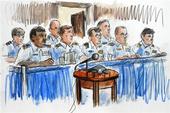
Subscribe to:
Posts (Atom)
